
Your oncologist has told you that you have Carcinoma of Unknown Primary Origin (CAPI). This information will help you better understand your treatment.
What is a Carcinoma of Unknown Primitive or CAPI?
Cancer is classified according to where it starts, not where it spreads. This initial location is essential in determining the treatment to be followed and the way in which cancer is referred to, such as lung or kidney cancer, for example. Even if cancer cells spread to other parts of the body, so-called metastases, cancer is still treated according to its original origin.
However, in some cases, the origin of these metastases remains unknown. This is known as CAPI (Carcinoma of Unknown Primary) or CUP (Cancer of Unknown Primary).
CAPIs account for less than 3% of cancers diagnosed each year. It is estimated that over 7,000 French people are diagnosed with CAPI every year.
How is the diagnosis made?
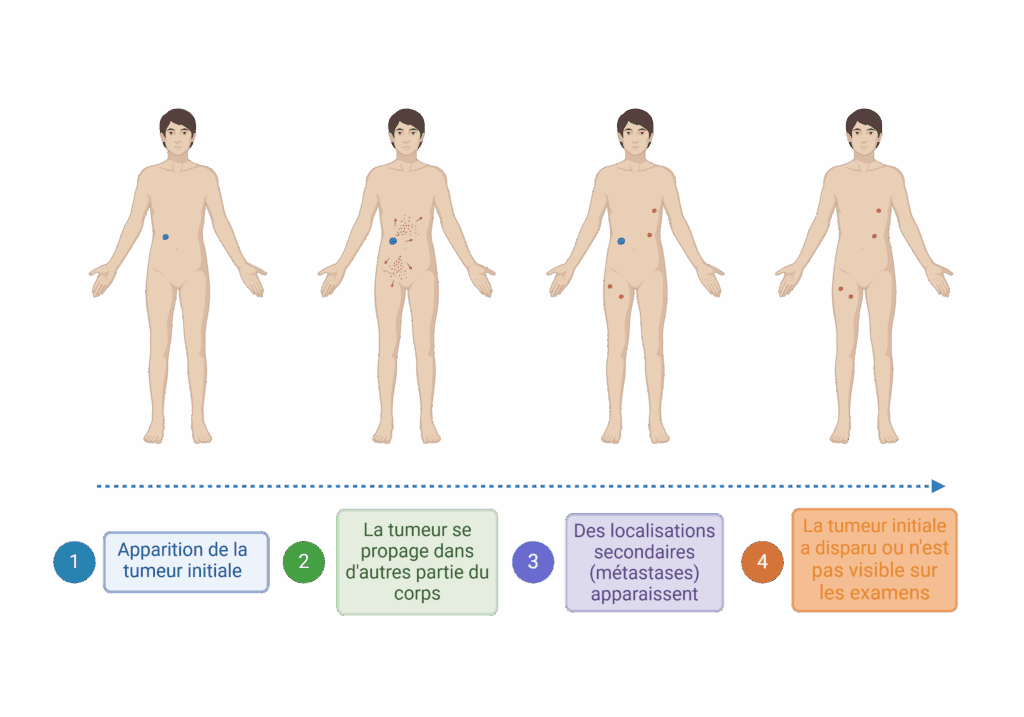
The diagnosis of CAPI is made when a sample or biopsy reveals the presence of cancerous cells, but their origin cannot be determined. This means that metastases are present, but the original tumour has disappeared. The appearance of the cancer cells observed does not allow them to be linked to a specific organ.
Here is a diagram explaining the process:
What is a biopsy and why is it important?
A biopsy is a medical examination in which a small sample of tissue is taken from a suspicious area of your body, often where a tumor has been detected.
This sample is then analyzed under the microscope by a specialized physician called an anatomopathologist. In the case of a carcinoma of unknown origin, biopsy is essential, as it enables us to :
- Confirm the presence of cancer cells
- Determining the exact type of cancer
- And sometimes to give clues as to the possible origin of the tumor.
This information is essential for guiding further tests and choosing the most appropriate treatment.
What's next?
You will be offered a PET scan and a blood test with tumor markers.
However, studies have shown that multiple examinations are not always necessary, and can sometimes delay the start of treatment.
Today, personalized analyses are available, using artificial intelligence to reclassify the tumor in 66% to 80% of cases, enabling more appropriate treatment to be proposed. These analyses take several weeks, but do not delay the start of treatment.
At the Centre Baclesse, patient files are discussed at a specific multidisciplinary meeting dedicated to this type of pathology. The Center also participates in national RCP meetings.
The diagnosis of cancer is an ordeal in itself. The indeterminate and rare nature of the disease makes acceptance even more difficult. Psychological support is available to accompany you.
What is the treatment?
Chemotherapy may be started pending the results of the analysis.
Chemotherapy can reach cancer cells present throughout the body, whether or not they are visible on tests. Treatment will be tailored to the results of personalized analyses.
Other treatments may include surgery or radiotherapy.
Personalized nursing care
At the Centre Baclesse, a support nurse provides personalized follow-up throughout the care process. She assesses needs, provides information, advice, support and guidance.
Her main responsibilities are to :
- Complete the information given by the referring doctor.
- Offer access to the Center's supportive care services.
- Communicate with the various professionals at the Centre Baclesse, but also in the region, to facilitate care.
In practice, she is involved right from the start of treatment. Support interviews are scheduled at key points in the treatment process: before and during chemotherapy, before radiotherapy, and at the end of treatment.
- Telephone helpline: 02 31 45 86 48 Monday to Friday, 9.30am to 11.30am.
- Secretariat: 02 31 45 41 03
- Location: Parcours nurses' offices are on the 6th floor.
Supportive care
Supportive care is the care and support required by patients throughout the course of their disease, in conjunction with specific oncology treatments where available. It is an integral part of treatment, designed to improve quality of life.
The support care department at the Centre Baclesse comprises a consultation service, a scheduled hospitalization service on the 4th floor and an ambulatory medicine service on the 3rd floor (CEMAB).
REMINDER
The Espace de Rencontres et d'Information (ERI) at the Centre Baclesse is at your disposal and can direct you to help and support associations.
Patient association
Rock4LIfe, the first French association entirely dedicated to people affected by CAPI, pursues 4 objectives:
- GATHER the 1st community of patients (from all possible backgrounds) affected by a CAPI.
- Connecting patients with the experts and structures they need.
- COMMUNICATE, RAISE AWARENESS, INFORM about CAPI.
- ORGANIZE festive, generous and daring charity events, musical or otherwise, to raise funds and collect donations.
Contact
Secretariat BLUE Sector
- Opening hours: Monday to Friday, 9 a.m. to 5 p.m.
- Telephone: 02 31 45 51 24
- Location: DRC, central consultations