What is a care pathway?
The care pathway includes all stages of treatment.
As soon as the diagnosis of cancer is confirmed, the doctor explains and gives the patient a Personalized Care Program (PPS), which summarizes the different stages of treatment. It may also include referral to supportive oncology care. Each patient follows his or her own personal care pathway.
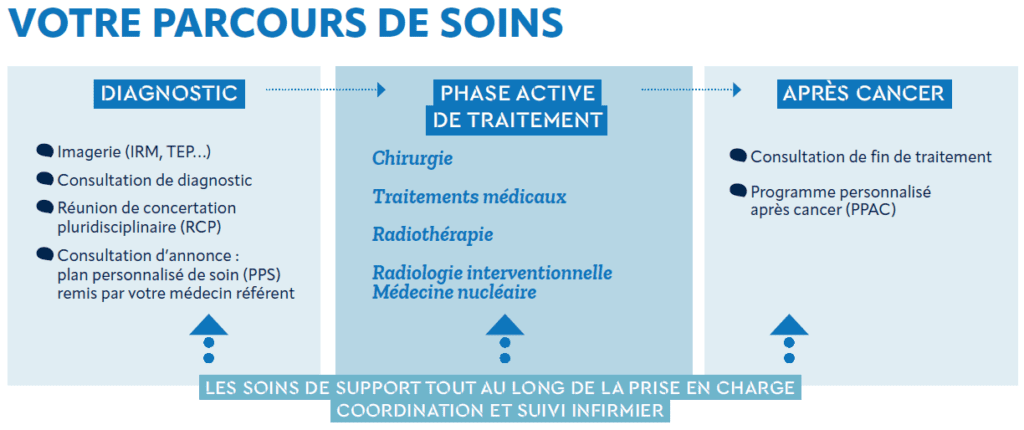
The care pathway is supported by a multi-disciplinary medical team and multi-professional caregivers, who act as a link with the attending physician and other healthcare professionals.
The players in your care at the Centre
Your referring doctor
At the Centre François Baclesse, it is the doctor who coordinates all the diagnostic and therapeutic stages, as well as your follow-up. He or she works in close collaboration with the Centre's teams and professionals in the community. He or she systematically informs your general practitioner (with your agreement), at every stage of your treatment.
Your care pathway nurses
This is a team of dedicated nurses. They are responsible for your personalized care throughout the entire treatment process, working closely with your referring doctor and all the professionals involved in your care, both inside and outside the Center, such as your GP, private nurse, pharmacist, etc.
Their role is to :
- Complete the information provided by the referring physician,
- Offer access to the Center's supportive care services.
The Parcours de soins nurses' offices are all located on the 6th floor of the Center (on the right as you exit the elevators).
Contacts for care pathway nurses
| THE TRAILS | Telephone hotlines |
|---|---|
| SEIN / SARCOME / CAPI | 02 31 45 86 48 |
| VADS / THORAX / NEURO-ONCOLOGY / ONCO-DERMATOLOGY | 02 31 45 40 71 |
| GYNECOLOGY / UROLOGY / DIGESTIVE | 02 31 45 86 74 |
Remote medical monitoring
Since December 2023, patients receiving treatment at the Baclesse Center have benefited from a new remote monitoring service. This medical telemonitoring device is the "Cureety" application, which specializes in oncology.
The platform is accessible from a smartphone, tablet, or computer, and improves continuity of care through a personalized and fluid relationship between patients and healthcare teams throughout the care pathway.
To find out more about remote medical monitoring at the Centre Baclesse, watch the video below.
Proton therapy course
Key points in care safety
The Multidisciplinary Consultation Meeting (RCP)
The RCP is a meeting attended by doctors from different specialties involved in patient care. The attending physician is systematically invited. Treatment decisions are made at the RCP, based on a strategic analysis of the patient's needs. At the end of the RCP, a detailed report is sent to the attending physician, and the discussion is reported back to the patient during a medical consultation, when the personalized care plan (PPS) is handed over.
At the Centre François Baclesse, several RCPs dedicated to the different cancers we treat are held every week.
Personalized Care Program (PPS)
Once the treatment proposal has been validated at the RCP meeting, a Personalized Care Program (PPS) is given to the patient by the referring physician. This PPS sets out the treatment stages and their chronology, providing an overall view of the patient's care pathway.
Continuity of care: city-hospital link
Consultations and hospitalizations at the Center are always the subject of a specific medical letter sent to the attending physician. The Center's referring physician is also informed.
Depending on the situation, a link can also be made with other healthcare professionals.
The personalized post-cancer care pathway (PPAC)
When treatment is complete, we speak of the "post-cancer" period. Medical surveillance is organized. Social support, recourse to supportive care or referral to outside professionals may be proposed. These elements are summarized in a Personalized Post-Cancer Plan.
To prepare for this period, patients are systematically offered an appointment with their referring doctor and the Parcours nurses.