

Quality and safety policy
The Centre François Baclesse is committed to a global approach to improving the quality and safety of care.
The Quality / Risk Management approach deployed at the Center for over 20 years guarantees users a high level of care, professionals an efficient working environment and the institution a privileged territorial positioning. It is supported by a large number of highly committed and active players.
Voluntary or mandatory certification procedures are becoming increasingly common (clinical research, biopathology department, tumor library, data processing center), and are now extending to care pathways, basic research and teaching (European Accreditation Compréhensive Cancer Center).
For the period 2024-2028, the Centre François Baclesse has identified 5 strategic priorities, which are set out in the establishment's project:
- Priority 1: Strengthen teams' commitment to the quality approach
- Area 2: Optimizing quality and risk management
- 3: Moving from risk management to safety culture
- Area 4: Measuring performance & aiming for excellence in certification procedures
- Axis 5: Leverage patient partnership & patient experience to improve patient care.
Our quality approach
The Centre François Baclesse embraces quality as one of its 4 core values and has translated this ambition into a number of quality initiatives:
- European accreditation by the Organization of European Cancer Institutes (OECI) for all the center's activities (care/teaching/research),
- Level A certification from the Haute Autorité de Santé (HAS) (obtained in November 2019 according to the V2014 standard),
- NF EN ISO 15189 accreditation (COFRAC) for the cancer biology/genetics laboratory and the anatomopathology department,
- ISO 9001 certification for clinical research, including the management and dispensing of experimental drugs,
- ISO 9001 certification for the data processing center,
- NFS 96-900 certification for the OVA Ressources tumor library and biological resource center,
- QUALIOPI certification for the Center's continuing education activities,
- CLIP2 early trial center accreditation by INCa.
Numerous professionals are involved in leading these initiatives, and each activity sector is deploying a continuous improvement approach to its practices and care safety.
Every year, the Center designs and develops an ambitious training program in the field of quality. One day, Quali'Day, is specifically dedicated to quality culture, bringing together over 600 professionals for workshops and conferences.
The level reached by our establishment is objectified by the results of the quality and safety of care indicators available online on the Haute Autorité de Santé (HAS) website: Qualiscope (Quality in hospitals and clinics).
Patients and users of the Centre are also involved in the quality and safety of care:
- informing professionals of any malfunctions they observe, so that they can be taken into account and dealt with by the facility's quality department,
- by participating in the e-Satis patient satisfaction assessment system,
- ensuring reliable identification at every stage of the process, by providing photo identification when the file is created,
- informing professionals of their medication or any event likely to influence their care.
The user representatives who sit on the users' commission play an active role in the policy of improving and securing care. They are privileged interlocutors in the relationship between patients and users and the institution.
Would you like to share your experience, or suggest ways of improving patient care? CONTACT US !
Certifications and accreditations
The Centre François Baclesse enjoys national and international recognition for its care and research thanks to several certifications and accreditations.
Accreditation Comprehensive Cancer Centre - Centre François Baclesse
June 26, 2020 - The Centre François Baclesse has been accredited as a "Comprehensive Cancer Centre" by the Organization of European Cancer Institutes (OECI), becoming the 5th French cancer center to obtain this label of excellence.
This recognition of quality is reserved for multidisciplinary cancer care institutions integrating care, research and training. Only establishments with a significant number of medical and technical skills, including clinical and translational research, are eligible for accreditation as a Comprehensive Cancer Centre. The excellence and quality of patient care at the Centre François Baclesse, at every stage of the treatment process, as well as access to innovation, have been recognized.
This European accreditation, obtained for 5 years, is the fruit of a continuous improvement process that is an integral part of the Centre François Baclesse's Establishment Project. It gives the Centre international visibility, which should facilitate the development of new research projects and new interactions for the benefit of patients.

HAS V2014 certification - Centre François Baclesse
October 23, 2019 - The Centre François Baclesse has been certified A by the Haute Autorité de Santé (HAS) for 6 years, the highest level.
HAS certification is an independent, mandatory assessment of the quality and safety of care provided by French public and private healthcare establishments. It is carried out by professionals (peers) appointed by the Haute Autorité de Santé, known as expert-visitors.
In particular, it assesses the company's ability to identify and control risks, and to implement best practices.
This excellent result is the fruit of an investment by all the Center's professionals. It is the result of all the steps taken to improve patient care and ensure safety.
The Centre's certification report is available on the Haute Autorité de Santé website:
NF EN ISO 15189 accreditation - Cancer Biology and Genetics Laboratory and Anatomy-Pathology Department of the Centre François Baclesse (Biopathology Department)
Since July 1, 2014, the Laboratoire de Biologie et de Génétique du Cancer (LBGC) has been accredited by COFRAC.
The deployment of the quality approach within the Anatomo Cyto-Pathology laboratory has enabled the Biopathology department to be accredited under no. 8-3264. Since February 2025, the Biopathology department has made the transition to the new v2022 version of ISO15189 (including delocalized biology).
The scope lines are available on the Cofrac website: https://www.cofrac.fr/

ISO 9001 Certification - Clinical Research and Therapeutic Trials Sector of the Pharmacy Department
In 2017, AFNOR awarded the Clinical Research Unit and the therapeutic trials sector of the Centre Baclesse pharmacy, ISO9001 version 2015 certification.
This certification was renewed in May 2023 (3rd cycle). The surveillance audit carried out in April 2024 demonstrated the effectiveness of the organization in optimizing the care and safety of patients included in clinical trials.
The award of this international certification recognizes the quality of our clinical research activity, for patients, physicians and our academic and industrial partners.
This recognition is proof that the Centre Baclesse is committed to a continuous quality improvement process based on a process and risk management approach.

ISO 9001 certification - Data processing center
The Cancéropôle Nord-Ouest (CNO) Data Processing Center (CTD) has been ISO 9001 certified since 2018.
The CTD-CNO, located at the Centre de Lutte Contre le Cancer Baclesse in Caen, has been certified ISO 9001 (version 2015) for its software administration, data management and biostatistics activities for research projects. This internationally recognized standard guarantees a high level of quality and safety in the organization of clinical trial data processing and analysis, for patients, physicians and academic partners alike.
By implementing this approach, the CTD has acquired tools that enable it to improve the services it provides and adapt to the needs and expectations of partners and funders, in a context of ongoing regulatory change.

NFS 96-900 certification for the OvaRessourcess Tumor Library and Biological Resource Center
The Tumorothéque de Caen Basse-Normandie (a joint structure with Caen University Hospital) and the Centre de Ressources Biologiques OvaRessources (dedicated to ovarian cancer pathology) have been certified together, according to the NF S 96-900 standard, since 2016.
This certification recognizes the quality of our work in preparing, preserving and making available biological resources for research purposes (and for healthcare in the case of TCBN), for patients, researchers and our public and private partners.
Obtained from AFNOR, it enables us to control risks thanks to reliable processes, and to prove the traceability and quality of samples to those involved in research.
Qualiopi certification: Centre Baclesse training organization
The Centre Baclesse has a training organization that offers short courses in oncology to healthcare professionals in the region.
Declared a training provider for over 30 years, and a Continuing Professional Development organization since 2013, the Centre Baclesse has been Qualiopi accredited since October 2021.
This certification was successfully renewed in June 2024 for 3 years (without non-conformity).

Quality and safety indicators
The Centre François Baclesse participates in the collection of national indicators for improving the quality of care and preventing nosocomial infections developed by the Haute Autorité de Santé.
Indicator results
Access the results of the Centre François Baclesse's quality and safety indicators on the national QualiScope website: See the sheet.
Processing of personal data for the collection of indicators
As part of the process of collecting quality and safety indicators, HAS collects and uses indirectly nominative personal data from patients randomly selected by healthcare establishments. HAS is responsible for processing this data.
For more information: Information notice for patients staying in healthcare establishments, whose medical records may be subject to data processing, as part of the collection of quality and care safety indicators. See the notice.
Inpatient satisfaction
In order to improve the quality of services and care offered to patients, our facility is an active participant in the national e-Satis inpatient satisfaction survey.
As part of this survey, you will be invited by e-mail to give your point of view on the quality of your care via a totally anonymous online questionnaire.
All results for the Centre François Baclesse and other healthcare establishments can be viewed on QualiScope
650 people take part in the day's events, which include lectures and workshops.
Care safety
Adverse events associated with care (AEIAS)
Adverse events associated with healthcare (AEAS) are all malfunctions - sometimes errors - that have a negative impact on a patient's care, even though the majority of them are avoidable. They are defined as unfavorable events for the patient, of a certain seriousness and associated with care provided during investigations, treatments or preventive actions.
The reporting of adverse events associated with healthcare by any healthcare professional or user helps to improve patient safety, through the lessons learned from their analysis and the implementation of improvement actions.
Patients and users of the Center are also involved in the quality and safety of care by reporting any malfunctions they observe to the professionals.

You can notify the Centre François Baclesse by e-mail of any undesirable event associated with care so that it can be dealt with by the establishment's Quality and Risk Management Department.
Please write to cfb-qual@baclesse.unicancer.fr
Pharmacovigilance: reporting adverse drug reactions
The purpose of pharmacovigilance is to monitor drugs and prevent the risk of adverse effects resulting from their use, whether these risks are potential or proven. It is a guarantee that applies throughout the life of a drug.
As soon as a link between an adverse reaction and a drug is suspected, even if it is not proven, a report must be made to the regional pharmacovigilance center (CRPV). Reports sent to the CRPV are recorded and analyzed at regional level, then forwarded to the French National Agency for the Safety of Medicines and Health Products (ANSM), which is responsible for the collective and national monitoring of health products, analyzing the reports transmitted and, if necessary, taking the necessary measures to reinforce patient safety. Reporting adverse reactions is an essential step in improving patient safety, as it enables manufacturers to improve the use of their products.
As a patient, you can report any adverse event related to the use of a medicine or other health product to the health authorities in just a few clicks, using the reporting form on the website signalement.social-sante.gouv.fr
We recommend that you inform the doctor treating you of any undesirable events at the same time.
Preventing healthcare-associated infections
Healthcare-associated infections (HAIs) are infections acquired during healthcare. Hospital-acquired infections are known as nosocomial infections. These infections can be caused by your own microbes (which are naturally present on your skin, in your digestive tract, in your mouth, etc.) or by microbes transmitted by the hands of caregivers, medical equipment or the environment.
They can be exacerbated by complex care procedures and a fragile state of health. Preventive measures are available to avoid their occurrence.
How to prevent them?
Prevention by caregivers
Preventive measures must be applied by all caregivers to all care provided to all patients, regardless of where the care is performed (including at home): these are known as standard precautions.
The most important of these precautions is hand disinfection, without jewelry, using a hydro-alcoholic solution.
Other measures include compliance with asepsis rules during care, disinfection of equipment and maintenance of premises.
Prevention by patients
You too can help us reduce the risk of healthcare-associated infection and prevent the spread of germs in the environment by observing a few simple rules of hygiene:
- hand hygiene: hydro-alcoholic solutions are there for you too! Use them before and after meals, after going to the toilet or blowing your nose, and when leaving and returning to your room (if your hands are soiled, use soap and water),
- coughing or sneezing : cover your mouth with your hand or a single-use handkerchief, dispose of used tissues in the trash, wear a surgical mask outside your room if you cough a lot (ask your caregivers),
- handling catheters, urinary catheters, dressings, etc. increases the risk of contamination. If you feel any discomfort due to these devices, report it to the team, who will take the necessary measures,
- special instructions may be given to you depending on the reason for your hospitalization or your state of health: for your health and safety, please follow them.
Prevention by visitors
To avoid bringing germs into the hospital and others back home, visitors must also take a few precautions: for your health and theirs, ask them to respect them!
- ask your loved ones to postpone their visit if they are ill (cold, gastroenteritis...) or accompanied by sick or frail children. If the visit cannot be postponed, inform the team and ask them what measures to apply (wearing a medical mask, etc.),
- ask them to rub their hands with hydro-alcoholic solution when they enter the room.
- as a general rule, it's best to limit the number of visitors to rooms (the more people, the more germs...),
- the soil in potted plants contains microbes which can be dangerous for your health: ask your friends and family to bring you something else (cut flowers, sweets, etc.),
- in your room:
- to guarantee the quality and safety of the care you receive, visitors must leave the room during treatment, and only professionals are authorized to touch medical equipment,
- to avoid contamination, ask your loved ones to use the public toilets rather than those in your room, to sit on the chairs rather than on the bed, and to respect the instructions given by the nursing staff,
- on leaving the room: they can again rub their hands with the hydro-alcoholic solution.
What kind of organization?
A Comité de Lutte contre les Infections Nososcomiales (Clin) (Nosocomial Infection Control Committee), made up of representatives from management, medical and paramedical staff and user representatives, plans a multi-year action program, including the following components:
- professional training,
- practice assessment,
- drafting of care procedures,
- monitoring the microbiological quality of the environment.
The themes chosen for these actions evolve according to national guidelines and the needs identified within the plant. In particular, they concern the following points
- develop prevention of healthcare-associated infections throughout the healthcare process, involving patients,
- reinforce the prevention and control of bacterial resistance to antibiotics,
- reduce the infectious risks associated with invasive procedures (surgery, venous access devices, endoscopy, etc.).
To implement this action program, the Clin relies on the Hygiene Operational Team, made up of healthcare professionals qualified in the prevention of infectious risks.
Identitovigilance
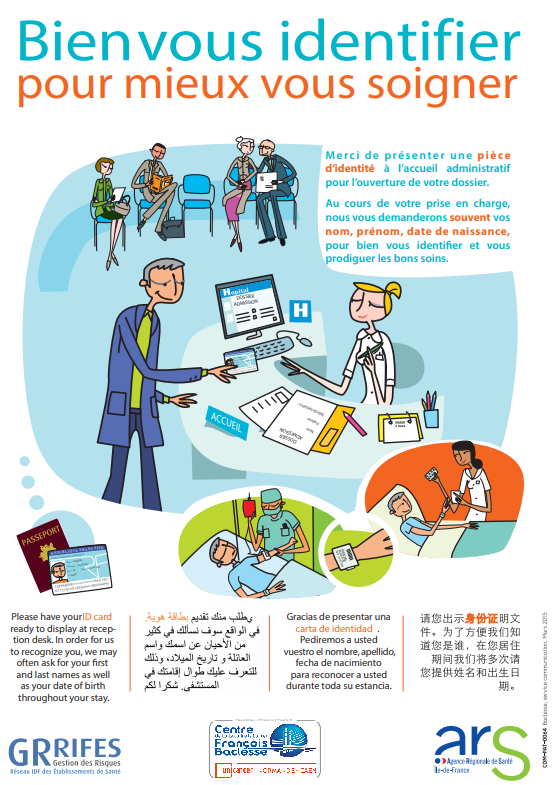
Your safety is a fundamental concern for all professionals at the Centre François Baclesse. The Centre has set up an organization to ensure the reliability of your identification at every stage of your care: this is what we call identitovigilance. At the Centre François Baclesse, the Cellule d'IdentitoVigilance is responsible for setting up a system to monitor and prevent errors and risks linked to patient identification.
Your identification is the first essential and fundamental step before any treatment.
This is why :
- You will be asked to show proof of identity when you create your file,
- You will be given an identification bracelet when you are admitted to hospital,
- We frequently ask for your first and last name and date of birth, at every stage of your treatment.
Don't hesitate to identify yourself each time you receive a new treatment.
Transfusion safety and hemovigilance
TheHemovigilance Unit at the Centre François Baclesse optimizes the safety of transfusions of labile blood products that may be administered to you.
Thanks to rigorous and regulated medical monitoring and control, from prescription to administration of the blood product and post-transfusion follow-up, the organization of this unit at the Centre meets transfusion safety standards.