
Proton therapy treatment requires coordination between the Center's medical teams and the physician(s) requesting the treatment.
Your proton therapy treatment pathway can only begin if the indication for proton therapy is validated at a multidisciplinary consultation meeting (RCP), following a review of your medical file by the physician requesting treatment.
Proton therapy care pathway
It includes a preparation session and a series of treatment sessions.
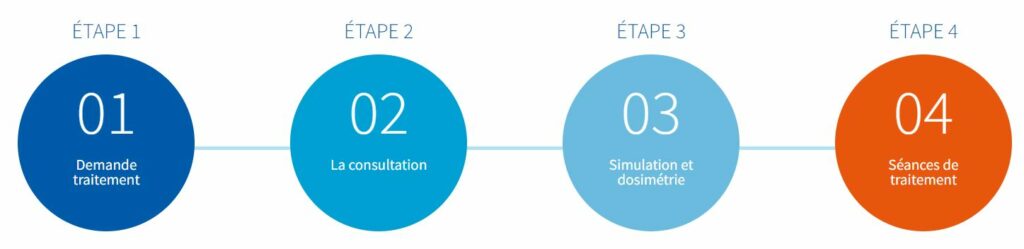
Processing request
The request for proton therapy treatment is made at the Réunion de Concertation Pluridisciplinaire (RCP) of the medical team initially caring for the patient.
This request, together with a complete medical file, must be sent to the radiotherapy department of the Centre François Baclesse. In practical terms, the medical file can be transmitted electronically via a link to a secure area which will be sent to the requesting physician.
The request is then submitted to a second specialized RCP (local or national) for an opinion on the relevance of the proton therapy indication.
If the request is accepted, the patient is offered a first appointment at the Centre François Baclesse.
The requesting physician is kept informed of the treatment. He or she has secure access to the patient's medical record, which is updated in real time. For this, the requesting physician will be directed to the Centre François Baclesse IT department.
Consultation
The first step in the proton therapy treatment process is a consultation with the radiation oncologist, who is the patient's referring physician at the Centre François Baclesse.
He informs the patient about his treatment and organizes his treatment with the help of the radiotherapy team.
Simulation and dosimetry
Preparing for treatment requires CT imaging of the tumor, known as simulation.
This is used to define the patient's position on the proton therapy machine and to simulate the treatment.
This preparation takes place in the radiotherapy department of the Centre François Baclesse.
To ensure the optimum position for treatment and patient comfort, customized "restraint" accessories can be used: head rests, support masks, knee rests, etc. The accessories used during the simulation phase will be repeated for each treatment session.
The patient is photographed (portrait and positioning) to ensure safe treatment. These photos are displayed on screens at the proton therapy operators' workstations during treatment sessions.
At the end of the simulation, the patient is given an identification sheet with his or her portrait photo. The patient must bring it with him/her each time he/she comes to the radiotherapy department.
The simulation lasts between 30 and 60 minutes.
The images collected during the scan are used to model the best possible treatment, i.e. the one that will be most effective on the tumor and least harmful to the surrounding healthy tissue. This optimization work, known as dosimetry, can take up to 15 days.
Treatment sessions
Proton therapy treatment takes place once a day, 5 days a week, for 3 to 7 weeks, depending on the treatment proposed and validated in a multidisciplinary consultation meeting.
Treatment sessions take place in the care unit located at the CYCLHAD proton therapy center, a 5-minute transport ride from the François Baclesse Center.
Sessions last between 20 and 40 minutes each.
Proton therapy treatment sessions at the CYCLHAD site take place between 7am and 10pm.
Chemotherapy is sometimes prescribed at the same time as radiotherapy treatment.
During the course of treatment, a weekly consultation is scheduled with a radiotherapist, to monitor tolerance of the treatment and adapt management.
A physician is also present on site every day, if required.
After the end of treatment, follow-up consultations with a requesting radiotherapist or the referring oncologist are scheduled to monitor the patient's long-term health.
Outpatient consultations
Secretariat
- Opening hours: Appointments are available Monday to Friday, 8am to 6.30pm.
- Phone: 02 31 24 34 48