
Plateforme Méthodologique nationale pour l'Etude et la Réduction des Inégalités Sociales en Cancérologie, accredited by the Ligue Nationale Contre le Cancer (National League Against Cancer)
Contact
The team
- Director: Pr Guy LAUNOY (Caen University Hospital)
The team comprises 6 people: 1 director (Guy LAUNOY), 1 researcher (Olivier DEJARDIN), 2 research engineers (Ludivine LAUNAY, Fanny DESHAYES-PINÇON), 1 technician (Catherine GRIN) and an administrative manager (Isabelle SALOMEZ). Each works respectively on tools for measuring access to care and/or social inequalities, improving geolocation techniques, project management or data geolocation.
Research activity
The MapInMed platform aims to make available its expertise and tools in the field of social inequalities and access to healthcare. Its research focuses on methodological improvements to the tools it provides, taking into account existing knowledge (bibliographic watch) and technical developments, and even the creation of new tools. The issues of social inequality and access to healthcare all require data to be geolocalized at different scales depending on the subject of the study (precise coordinates (x,y), allocation of the IRIS -Ilôt Regroupé pour l'Information Statistique, of the commune...). This is carried out by the platform using tools adapted to the study's needs, after CNIL authorization.
Technical resources
It uses regularly updated geographic data obtained from official suppliers (IGN, ESRI France, HERE, etc.). Staff are trained in the use of the software used, mainly ArcGIS ©.
Major publications
The methodology for building an index of accessibility to primary care in metropolitan France (the SCALE index) was published in Plos One in August 2019 (Launay L, Guillot F, Gaillard D, Medjkane M, Saint-Gérand T, Launoy G, Dejardin O. Methodology for building a geographical accessibility health index throughout metropolitan France. PLoS One. 2019;14(8):e0221417. ). This index, produced in collaboration with the UMR CNRS 266 IDEES Caen laboratory, is built at the scale of the residential area.
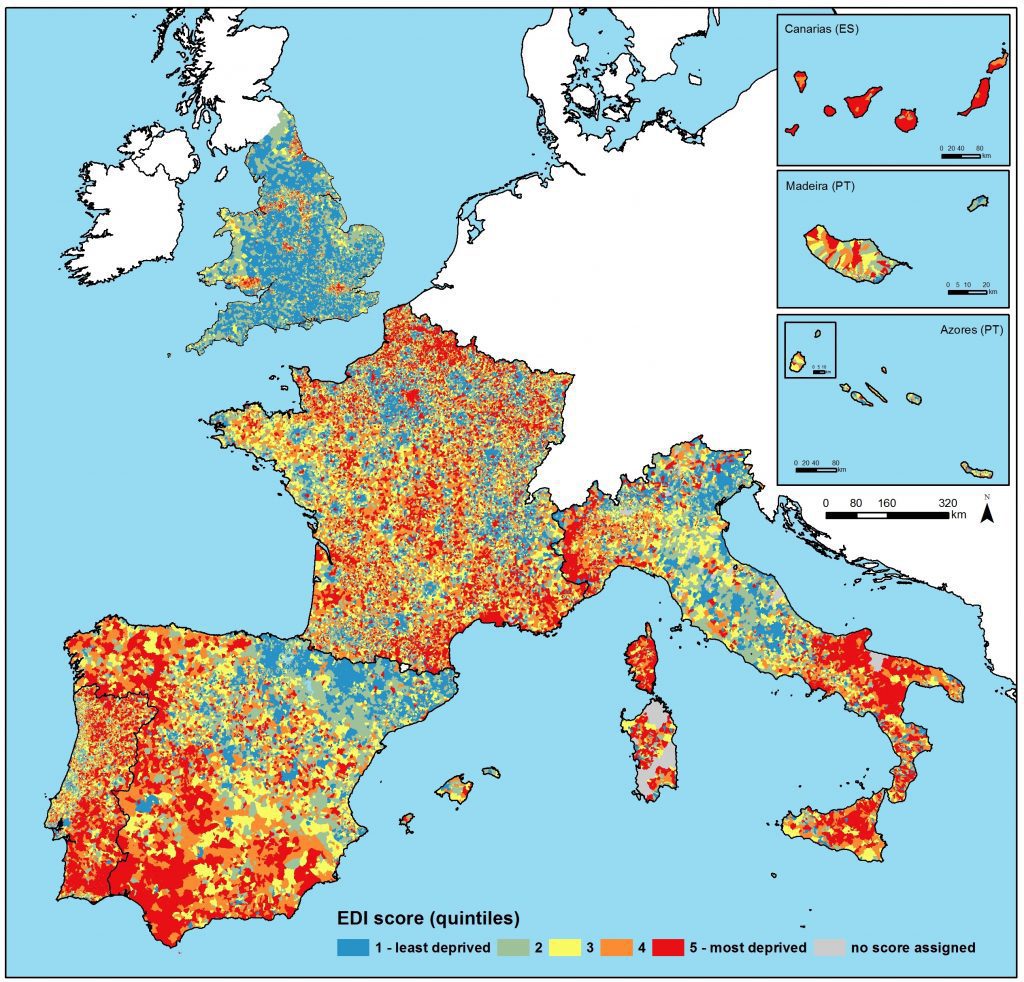
The European Deprivation Index is a European index of deprivation on an aggregate scale. It has been the subject of various publications both in its national version (Pornet C, Delpierre C, Dejardin O,, Grosclaude P, Launay L, Guittet L, Lang T, Launoy G. Construction of an adaptable European transnational ecological deprivation index: the French version. J Epidemiol Community Health 2012;66:982-9.; Guillaume E, Pornet C, Dejardin O, Launay L, Lillini R, Vercelli M, Marí-Dell'Olmo M, Fernández Fontelo A, Borrell C, Ribeiro AI, Pina MF, Mayer A, Delpierre C, Rachet B, Launoy G. Development of a cross-cultural deprivation index in five European countries. J Epidemiol Community Health. 2016;70(5):493-9. ) and its development on a European scale (Ribeiro AI, Launay L, Guillaume E, Launoy G, Barros H. The Portuguese version of the European Deprivation Index: Development and association with all-cause mortality. PLoS One. 2018;13(12):e0208320.; Zadnik V, Guillaume E, Lokar K, Žagar T, Primic Žakelj M, Launoy G, Launay L. Slovenian Version of The European Deprivation Index at Municipal Level. Zdr Varst. 2018;57(2):47-54).
Partnerships
- Cancer registries,
- Organized cancer screening management structures,
- Agence Régionale de la Santé,
- Cancéropôle Nord-Ouest,
- the Cancéropôle Nord-Ouest Data Processing Center.
- approved by the Ligue Nationale Contre le Cancer,
- French National Cancer Institute,
- Santé Publique France,
- FRANCIM,
- organized cancer screening management structures.
- Cancer registry.