
Contact
Secretariat
- Opening hours: Monday to Friday, 8 a.m. to 5 p.m.
- Telephone: 02 31 45 50 54
- Location: 3rd floor
Department tasks
Care mission
The laboratory's activities cover the fields of clinical biology, hereditary cancer genetics and tumor genetics.
The laboratory team carries out the main biochemistry and haematology analyses essential to the care of cancer patients, and provides prescribers with the resources they need to meet their requirements.
The department provides constitutional genetics services for the management of hereditary predispositions to cancer, in particular breast and ovarian cancer, by searching for mutations in predisposition genes for breast, ovarian and digestive cancers, by searching for mutations in genes involved in these pathologies. It analyzes index cases using high-throughput sequencing, and offers molecular predictive diagnosis of a known mutation for relatives. The department carries out additional tests, either to demonstrate the involvement of a mutation in a cancer predisposition context (e.g. RNA studies using RNASeq and Mini-genes), or to deepen molecular analysis in the absence of an identified mutation (e.g. genotype extension).
Finally, its tumor genetics activity (tumor genotyping and circulating free tumor DNA), applied mainly to colon, ovarian, breast and prostate cancers, aims to adapt the therapeutic management of cancer patients (targeted therapies) in conjunction with a "molecular" multidisciplinary consultation meeting.
Research mission
The laboratory team carries out research projects in the field of cancer genetics as part of INSERM Unit U1245 (hereditary predisposition to cancer). It houses the SéSAME high-throughput sequencing platform and relies on a team of bioinformaticians for dedicated developments in this field.
The projects developed focus mainly on the search for "missing heredity" in the context of breast and ovarian cancer predisposition syndromes:
- The study of genetic heterogeneity ;
- Study the contribution of splicing mutations in genes involved in this predisposition using a high-throughput approach (RNASeq Long-read, Midi-gènes) and a search for structural variants (DNASeq Long-read).
Teaching mission
- Courses at the UFR Santé and as part of the M2R "Approches Omiques" program
- Welcome and supervise students in Master 1/2, BTS, IUT, interns, externs and supervise science theses and professional theses.
- FST Bioinformatics (level 2)
- FST Innovation and Research
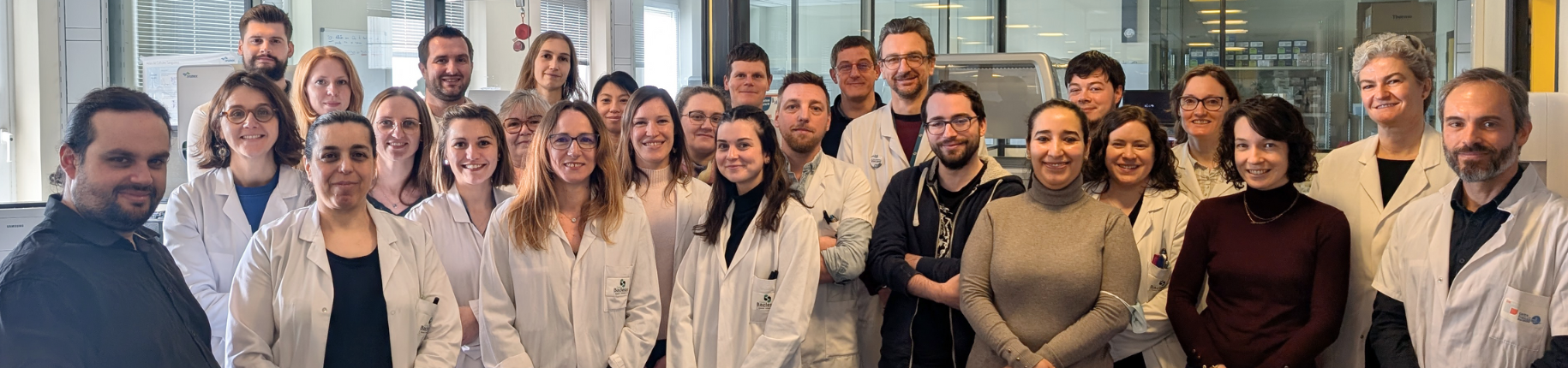
The team
- Manager: Dr Laurent CASTERA
- Laboratory manager: Fabrice GUICHARD
- Genetics expert: Dr Nicolas GOARDON
- Biologists: Dr. Flavie BOULOUARD, Dr. Laurent CASTERA, Dr. Sophie KRIEGER, Dr. Raphaël LEMAN, Dr. Agathe RICOU, Dr. Louise DURAND
- BioPathology Department Qualitician: Florian DOMIN
Care and Expertise
Medical biology
To meet the needs of the center's departments, the laboratory performs general biology analyses for inpatients and outpatients (mainly blood counts and formulas, hemostasis tests, ionograms and tumor marker assays). The department also analyzes fluids (pleural, peritoneal, etc.). It may also receive samples from external services for specific assays, such as certain tumor markers. Sample-taking procedures are described in the Biopathology Department's sample-taking manual, available at Thesi (Documents section).
Genetics
In the context of hereditary predisposition to breast and ovarian cancer, the laboratory analyzes the 13 diagnostic genes(BRCA1, BRCA2, PALB2, RAD51C, RAD51D, TP53, CDH1, PTEN, MLH1, MSH2, MSH6, PMS2, EPCAM) recommended by the Genetics and Cancer group (from a panel of 61 genes) by high-throughput sequencing (NGS) in patients (index cases) who have benefited from an upstream oncogenetic consultation.) The average turnaround time for these analyses is less than a month. The prescription form and sampling procedures are available at Thesi (Documents section).
Prix Unicancer de l'innovation 2023 - Digital/data at the service of the patient category:
Development of a national database system for constitutional oncogenetics (Génétique et Cancer group; consortum UNICANCER) FrOG-database
SEE THE VIDEO
In addition, with a view to adapting the management of cancer patients and enabling them to benefit from certain targeted therapies, the laboratory has developed high-throughput sequencing (NGS) of gene panels of therapeutic interest in paraffin-embedded tumors, within a timeframe compatible with therapeutic management (average delay of less than 3 weeks). The laboratory also tests tumors for micro-satellite instabilities. The prescription form for somatic genetics analyses is available on Thesi (Documents section).
Prix Unicancer de l'innovation 2022 - Access to innovation category:
GIScar: a genomic instability score for ovarian cancers developed by a CLCC
READ ARTICLE
As part of the Molecular PCR, an analysis aimed at the therapeutic management of patients with a therapeutic impasse is based on the sequencing of a large panel of more than 600 genes, combined with the identification of fusion transcripts of around 50 genes by simultaneous sequencing of DNA and RNA extracted from tumors.
The list of available analyses is available on Thesi (Documents section).
Service equipment
Genetics
- Nucleic acid extraction robot: QIAsymphony (QIAGEN)
- Thermal cyclers, including one qPCR
- ABI3500 Capillary Sequencer, Thermofischer
- 2 Illumina high-throughput sequencers
- 1 AVITI24 high-throughput sequencer, Element Biosciences
- Nanopore long-read sequencer
- 2 Hamilton dispensing robots
- covaris R230 sound level meter
- Compute farms and storage servers
General biology
- Hematology: XN-1000 (Sysmex)
- Hemostasis: STA Compact Max 3 (Stago)
- Biochemistry: Cobas pure(Roche)
- ABL90 Flex PLUS blood gas analyzer (Radiometer)
Results
Accreditation
Since July 1, 2014, the Cancer Biology and Genetics Laboratory (LBGC) has been accredited by COFRAC.
Deployment of the quality approach within the Anatomo Cyto-Pathology laboratory has enabled the Biopathology department to be accredited under no. 8-3264. Since February 2025, the Biopathology Department has made the transition to the new v2022 version of ISO15189 (including delocalized biology).
Span lines are available on the Cofrac website: https://www.cofrac.fr/
Activity Data for 2024–2025
In the context of hereditary predispositions to breast, ovarian, and colorectal cancers, as well as polyposis, the laboratory has provided services to 3,426 families by sequencing a panel of 61 genes using next-generation sequencing (NGS) within a median turnaround time of 15 days.
The laboratory has performed:
- 1,840 presymptomatic tests among family members (+1% compared to 2024)
- 1,542 somatic genetic analyses of tumors (+18% compared to 2024)
Research areas / Projects
- COVAR: biomedical study of familial segregation of genetic variants with disease (UNICANCER Genetics and Cancer Group)
- Study of splicing alterations by RNASeq (INSERM U1245)
- Biostatistics applied to the study of rare variants (AAP emerging project CNO 2015)
- Definition of new splicing prediction algorithms (LBGC-U1245 collaboration with GGC Epissage and ENIGMA).
- Detection of somatic CNVs
- Constitutional mosaicism, circulating tumor DNA or clonal hematopoiesis: pitfalls and challenges of NGS-detected low allelic fraction variants in constitutional genetics
- Development of a national database system for constitutional oncogenetics (Genetics and Cancer group; UNICANCER consortium)
- Exploration of the non-coding genome
- DOMENICA study on endometrial cancers
- HERO: HRD test evaluation in ovarian cancer
Publications
- Leman, R; Muller, E; Legros, A; Goardon, N; Chentli, I; Atkinson, A & al, Validation of the Clinical Use of GIScar, an Academic-developed Genomic Instability Score Predicting Sensitivity to Maintenance Olaparib for Ovarian Cancer, Clin Cancer Res, 2023, 29, 4419-4429
- Leman, R; Parfait, B; Vidaud, D; Girodon, E; Pacot, L; Le Gac, G & al, SPiP: Splicing Prediction Pipeline, a machine learning tool for massive detection of exonic and intronic variant effects on mRNA splicing, Hum Mutat, 2022, 43, 2308-2323
- Neviere, Z; Coquan, E; Brachet, PE; Meriaux, E; Bonnet, I; Krieger, S & al, Outcomes of Patients with Metastatic Castration-Resistant Prostate Cancer According to Somatic Damage DNA Repair Gene Alterations, Curr Oncol, 2022, 29, 2776-2791
- Caputo, SM ; Golmard, L ; Léone, M ; Damiola, F ; Guillaud-Bataille, M ; Revillion, F & al, Classification of 101 BRCA1 and BRCA2 variants of uncertain significance by cosegregation study: A powerful approach, Am J Hum Genet, 2022, 108, 1907-1923
- Morice, PM ; Coquan, E ; Weiswald, LB ; Lambert, B ; Vaur, D ; Poulain, L, Identifying patients eligible for PARP inhibitor treatment: from NGS-based tests to 3D functional assays, Br J Cancer, 2021, 125, 7-14
- Boulouard, F ; Kasper, E ; Buisine, MP ; Lienard, G ; Vasseur, S ; Manase, S & al, Further delineation of the NTHL1 associated syndrome: A report from the French Oncogenetic Consortium, Clin Genet, 2021, 99, 662-672
- Callens, C; Vaur, D; Soubeyran, I; Rouleau, E; Just, PA; Guillerm, E & al, Concordance Between Tumor and Germline BRCA Status in High-Grade Ovarian Carcinoma Patients in the Phase III PAOLA-1/ENGOT-ov25 Trial, J Natl Cancer Inst, 2021, 113, 917-923
- Bardet, S ; Goardon, N ; Lequesne, J ; Vaur, D ; Ciappuccini, R ; Leconte, A & al, Diagnostic and prognostic value of a 7-panel mutation testing in thyroid nodules with indeterminate cytology: the SWEETMAC study, Endocrine, 2021, 71, 407-417
- Beddok, A ; Krieger, S ; Castera, L ; Stoppa-Lyonnet, D ; Thariat, J, Management of Fanconi Anemia patients with head and neck carcinoma: Diagnosis and treatment adaptation, Oral Oncol, 108
- Leman, R ; Tubeuf, H ; Raad, S ; Tournier, I ; Derambure, C ; Lanos, R & al, Assessment of branch point prediction tools to predict physiological branch points and their alteration by variants, BMC Genomics, 2020, 21, 86
- Leman, R ; Harter, V ; Atkinson, A ; Davy, G ; Rousselin, A ; Muller, E & al , SpliceLauncher: a tool for detection, annotation and relative quantification of alternative junctions from RNAseq data, Bioinformatics, 2020, 36, 1634-1636
- Lopez-Perolio, I ; Leman, R ; Behar, R ; Lattimore, V ; Pearson, JF ; Castéra, L & al , Alternative splicing and ACMG-AMP-2015-based classification of PALB2 genetic variants: an ENIGMA report, J Med Genet, 2019, 56, 453-460
- Castéra, L; Harter, V; Muller, E; Krieger, S; Goardon, N; Ricou, A & al , Landscape of pathogenic variations in a panel of 34 genes and cancer risk estimation from 5131 HBOC families, Genet Med, 2018, 20, 1677-1686
- Leman, R ; Gaildrat, P ; Le Gac, G ; Ka, C ; Fichou, Y ; Audrezet, MP & al , Novel diagnostic tool for prediction of variant spliceogenicity derived from a set of 395 combined in silico/in vitro studies: an international collaborative effort, Nucleic Acids Res, 2018, 46, 7913-7923
- Caputo, SM ; Léone, M ; Damiola, F ; Ehlen, A ; Carreira, A ; Gaidrat, P & al , Full in-frame exon 3 skipping of BRCA2 confers high risk of breast and/or ovarian cancer, Oncotarget, 2018, 9, 17334-17348
Partnerships
At regional level
- INSERM U1245: Genomic and Personalized Medicine in Cancer and Neurological disorders
- Caen University Hospital: Genecan platform
- INSERM U1086: ANTICIPE Interdisciplinary research unit for cancer prevention and treatment
At national level
- INCa
- French bioinformatics network for NGS diagnosis in oncology" project
- Participation in the project to create a national somatic genetics database
- Oncogenetics and PARP inhibitors
- ITMO Cancer expert committee for precision medicine in oncology
- Method validation in somatic genetics (NGS)
- ANPGM
- NGS method validation
- NGS Quality Group
- NGS Reporting Group
- Second sampling workgroup
- Bioinformatics working group
- Genetics and Cancer Group
- Board member of the Genetics and Cancer Group
- Practitioners group
- Breast/ovarian lab group
- RNA group
- COVAR Group
- CANSOP group (clinical-biological basis)
- Tumospec project
- French Oncogenetics Database: Cancer predisposition gene database project
- UNICANCER
- BioPathology working group
- Participation in the COFRAC Human Health Section working group - NGS and Accreditation; Genetics: adapting accreditation to bioinformatics platforms
- Creation in 2018 of the BIOINFODIAG association (French Bioinformatics Network for Diagnostics)
At international level
- ENIGMA: Evidence-based Network for the Interpretation of Germline Mutant Alleles
- RNAseq method validation project
- Tissue splicing profile project
- GA4GH: BRCA challenge
Useful documents for healthcare professionals
The catalog of analyses, as well as the procedures for carrying out the examinations, are available at Thesi.
Complaint / Suggestion
In the event of a complaint or suggestion to the laboratory, a dedicated form is available on Thesi.
Don't forget to include your contact details so that the laboratory can provide you with a response.