
Welcome to the Nuclear Medicine Department
The Nuclear Medicine Department performs medical imaging exams and certain treatments using radioactive drugs.
To diagnose a disease
Diagnostic nuclear medicine makes it possible to observe how certain organs function or to identify diseased tissue.
To do this, a mildly radioactive medication is administered to the patient. Its distribution throughout the body is then visualized using tests called scintigraphy or PET scans (positron emission tomography). These images provide additional information to complement other medical tests.
To treat certain diseases
Nuclear medicine can also be used for therapeutic purposes. This approach, known as targeted internal radiation therapy (TIRT), involves administering a radioactive drug that specifically binds to diseased cells.
The emitted radiation then acts directly on these cells, enabling targeted treatment while minimizing exposure to the surrounding healthy tissue.
Theranostics
Personalized medicine is at the heart of what we do: by combining a diagnostic test with a targeted treatment—an approach known as theranostics—we help ensure that each patient receives the most appropriate treatment option.
Make an appointment
Secretariat
- Hours: Mondaythrough Friday, 8:30 a.m. to 5:00 p.m.
- Phone:02 31 45 50 32
- Fax:02 31 45 51 01
- Email: secretariat.medecinenucleaire@baclesse.unicancer.fr
- Location: Centre ground floor
Hospitalization
Hospitalization in the Vectorized Internal Radiotherapy Treatment Unit
- Open: 24-hour service
- Hospital secretariat: Monday to Friday, 8.30am to 4.30pm: 02 31 45 50 50 ext. 53.73
- Nursing office: 02 31 45 50 50 ext. 53.73
- Location: 7th floor
- Visitors are not allowed.
Department tasks
Care mission
The Nuclear Medicine Department specializes in cancer and endocrine imaging.
Its main mission is to carry out :
- Scintigraphy: bone, thyroid, left ventricular ejection fraction (LVEF), sentinel lymph node mapping for cancers of the breast, skin, head and neck, and gynecological cancers
- PET/CT: 18FDG, 68Gallium-PSMA, 68Gallium-DOTATOC, 18Fluorocholine, 18F-DOPA
- Thyroid pathology consultations (thyroid nodules, thyroid cancer, hyperthyroidism, hypothyroidism, etc.)
- Thyroid ultrasounds and thyroid fine-needle aspirations.
The department has launched a"Rapid Thyroid Screening Day" to provide a comprehensive evaluation of thyroid nodules.
- Vectorized Internal Radiotherapy (VIR) Treatments:
– Benign and malignant (cancerous) thyroid diseases (131I)
– Prostate cancer (¹⁷⁷Lutetium-PSMA: Pluvicto©, ²²³Radium: Xofigo©)
– Neuroendocrine tumors and meningiomas (¹⁷⁷Lutetium-DOTATATE: Lutathera©)
– Other diseases and cancers in the context of clinical trials
The department has established dedicated RIV care pathways managed by a coordination unit.
Research mission
The department participates in research activities in nuclear medicine and thyroid disorders.
The main areas of research are:
- Vectorized Internal Radiation Therapy
- Thyroidology
- PET: Instrumentation and New Tracers
- Parathyroid Glands and 18Fluorocholine PET
- Dosimetry
- Artificial Intelligence
- Radiopharmacy
Teaching mission
The Nuclear Medicine Department participates in training programs and serves as a clinical rotation site for medical residents and interns, pharmacy residents and interns, medical radiology technician trainees, and medical physics students.
The department's medical physicist also works with students in the Master's 2 program in radiation protection at Caen.
The team
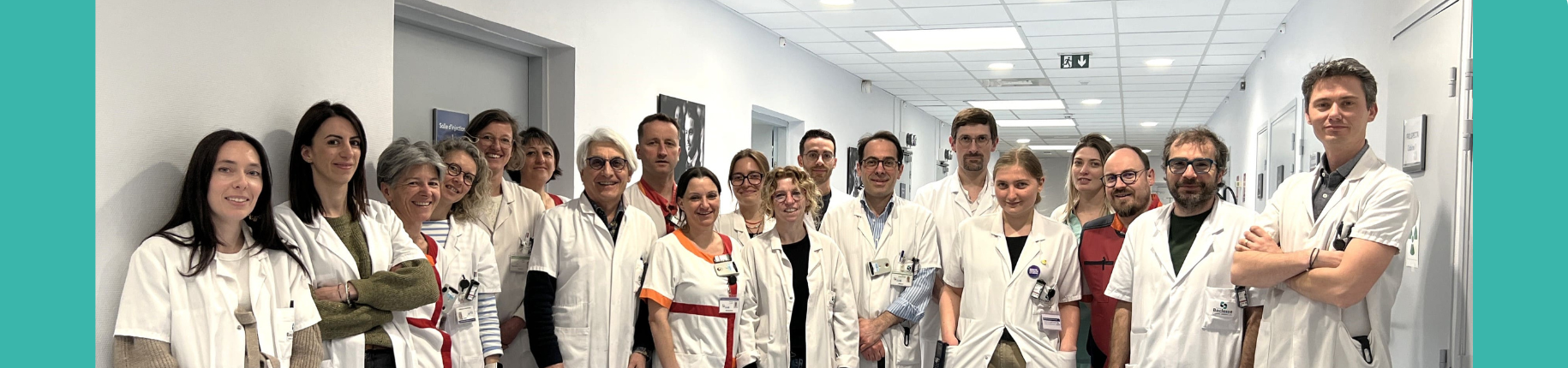
- Department Head: Dr. Renaud CIAPPUCCINI
- RIV Unit Director: Dr. Elisabeth QUAK
- Health executive: Antoine MARIE
- Nuclear Medicine Physicians: Dr. Renaud CIAPPUCCINI, Dr. Charline LASNON, Dr. Elisabeth QUAK
- Thyroid Unit: Dr.Paul-Antoine BOMPAIN, Dr. Candice BULKE, Dr. Renaud CIAPPUCCINI, Dr. Véronique LE HENAFF, Dr. Barbara LIREUX
- Radiation Protection: Alain BATALLA, Sophie DE SAINT VAAST
- Medical physicist: Cyril JAUDET
- Radiopharmacists: Dr Gauthier FOUCRAS, Dr Anaïs PRIGENT
- 15 Medical Radiology Technicians
- 2 Nursing Assistants
- 5 Medical Assistants
Equipment
- 3 gamma cameras :
- 1 BRIVO GE (2016)
- 1 INTEVO bold Siemens (2020) coupled to an X-ray location scanner
- 1 Pro-SPECTA Siemens (2025) paired with a positioning X-ray scanner
- 1 Philips Vereos CT scanner (2017)
- 5 radiation-shielded rooms
Accreditations and Activities
- Accreditations: EARL FDG PET/CT Center of Excellence – EARL Theranostics Center of Excellence, Level 2
- Expert center for the national TUTHYREF network (THYroid REFractory Tumors)
In 2025, the nuclear medicine department performed:
- More than 5,000 scintigraphy procedures
- More than 5,700 TEP-TDM
- More than 2,300 thyroid consultations
- More than 240 consultations for the rapid thyroid screening program
- More than 400 treatments using Vectorized Internal Radiotherapy
Partnerships, Collaborative Groups of Learned Societies
- At the national level: TUTHYREF, GTE, SFE, and GRT, as well as various working groups of the French Society of Nuclear Medicine (SFMN)
- Working Groups of the French Society of Medical Physics (SFPM), GANIL, CYCERON, CERMN, and IMOGERE
- Internationally: EANM , ETA, EORTC, EFOMP
Scientific publications
The research activities of the nuclear medicine team result in regular publications in leading scientific journals, both nationally and internationally. A selection of publications from the past five years is presented below.
- [177Lu]Lu-dota-tate versus sunitinib in patients with metastatic progressive neuroendocrine tumors of the pancreas (OCLURANDOM): a randomized, controlled, phase 2 trial. Baudin E, Durand A, Beron A, Smith D, Déandreis D, Taieb D, Ansquer C, Dierickx L, Deshayes E, Hentic O, Moalla S, Menu Y, Lebtahi R, Assenat E, Touchefeu Y, Guimbaud R, Dahan L, Lamartina L, Cheurfa N, Quak E, Bouhier-Leporrier K, Haissaguerre M, Hindie E, Cao CD, Lombard-Bohas C, Jannin A, Walter T, Ducreux M, Chaib S, Hadoux J, Foulon S. Lancet Oncol. June 2026;27(6):699-710. doi: 10.1016/S1470-2045(26)00108-7.
- StableBF₂ Boracycles as Versatile Reagents for Selective Ortho C–H Functionalization. Shinde GH, Babiker J, Mebrahtu M, Prigent A, Foucras G, Aher YN, Noa FMA, Johansson MJ, Košmrlj J, Jansen-van Vuuren RD, Cailly T, Sundén H. Angew Chem Int Ed Engl. Feb 16, 2026;65(8):e18421. doi: 10.1002/anie.202518421. Epub Jan 16, 2026.
- Nuclear Medicine and Thyroid Cancers in 2024: Iodine-131, PET, and New Theranostic Approaches . Ciappuccini R, Nascimento C, Edet-Sanson A, Bardet S. Bull Cancer. Oct 2024;111(10S1):10S64-10S72. French. doi:10.1016/S0007-4551(24)00409-0.
- ENDOCAN TUTHYREF Network Consensus Recommendations: Anaplastic Thyroid Cancer. Lamartina L, Jannin A, Decaussin-Petrucci M, Bardet S, Escande A, Ciappuccini R, Borson Chazot F, Al Ghuzlan A, Do Cao C, Hadoux J. Ann Endocrinol (Paris). July 2025;86(4):101788. doi: 10.1016/j.ando.2025.101788. Published online May 9, 2025.
- F18-Choline PET/CT vs. MIBI SPECT/CT in the Surgical Management of Primary Hyperparathyroidism: A Diagnostic Randomized Clinical Trial. Quak E, Lasne-Cardon A, Cavarec M, Lireux B, Bastit V, Roudaut N, Salaun PY, Keromnes N, Potard G, Vaduva P, Esvant A, Jegoux F, de Crouy-Chanel O, Devillers A, Guery C, Lasnon C, Ciappuccini R, Legrand B, Estienne A, Christy F, Grellard JM, Bardet S, Clarisse B. JAMA Otolaryngol Head Neck Surg. Aug. 1, 2024;150(8):658-665. doi:10.1001/jamaoto.2024.1421.
- Artificial intelligence-based PET denoising could enable a two-fold reduction in [18F]FDG PET acquisition time in digital PET/CT. Weyts K, Lasnon C, Ciappuccini R, Lequesne J, Corroyer-Dulmont A, Quak E, Clarisse B, Roussel L, Bardet S, Jaudet C. Eur J Nucl Med Mol Imaging. September 2022;49(11):3750-3760. doi: 10.1007/s00259-022-05800-1. Published online May 20, 2022