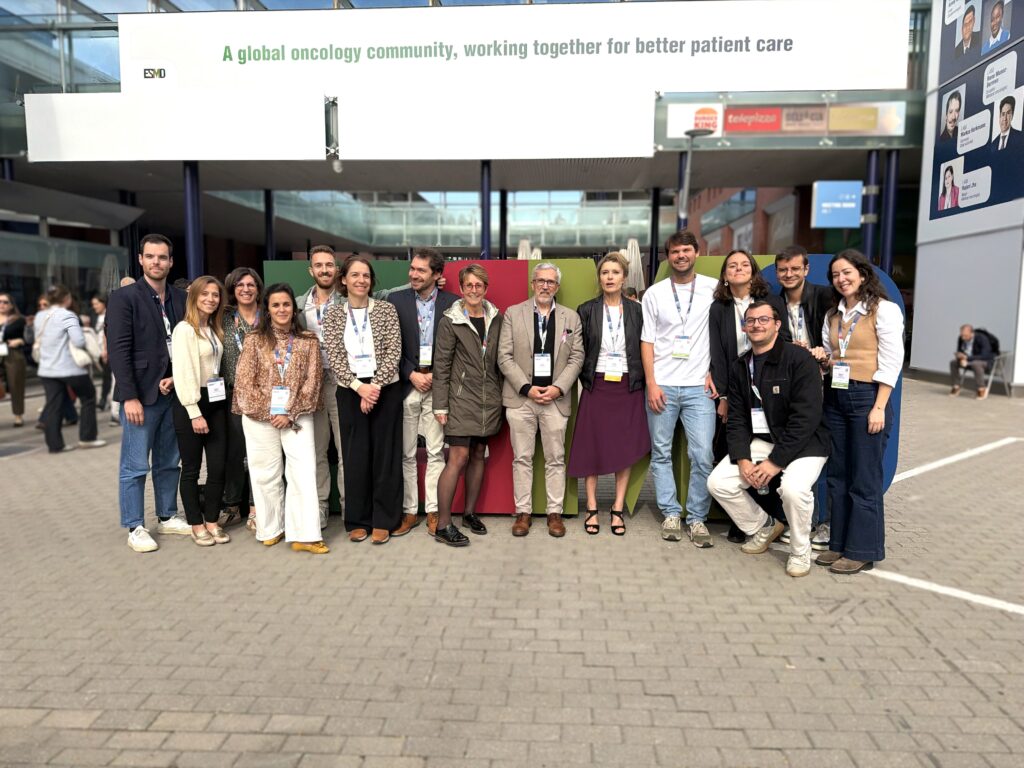
From October 23 to 27, 2026, the European Society for Medical Oncology (ESMO) Congress brought together oncology specialists from around the world in Madrid. Professionals from the Baclesse Center participated by presenting studies and research findings to the scientific community.
The contributions of the professionals at the Baclesse Center cover several areas of oncology: radiation therapy, nuclear medicine, gastrointestinal, urological, and gynecological cancers, as well as clinical research.
Scientific contributions in several fields of oncology
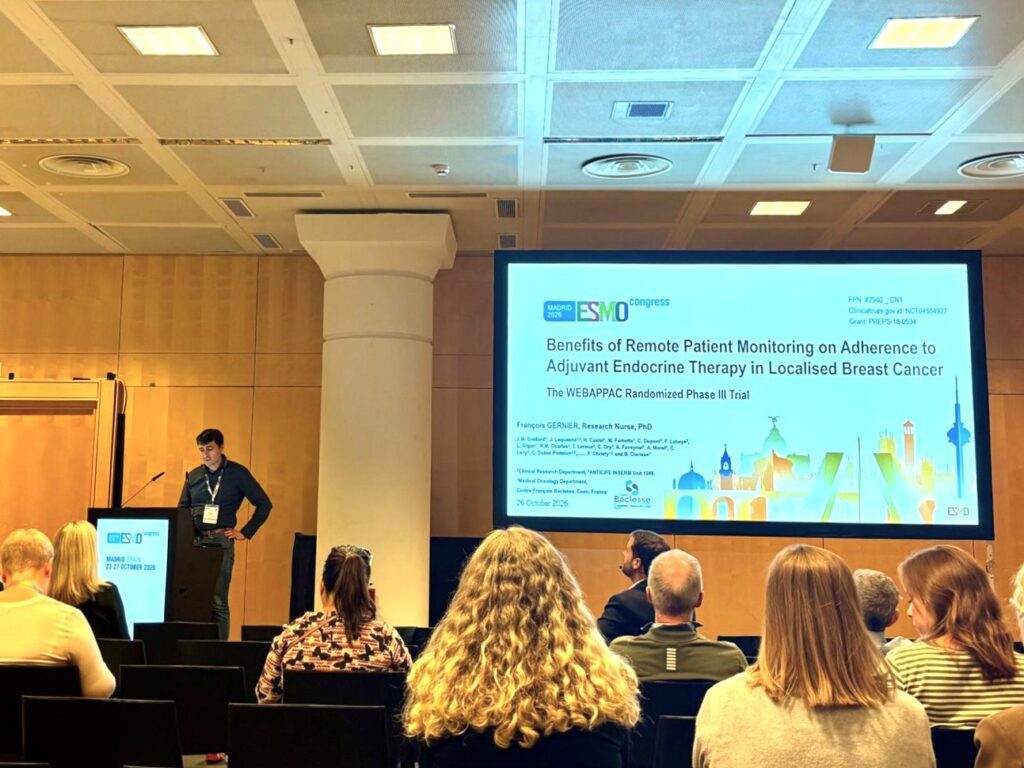
Prof. Juliette Thariat spoke during a “Challenge Your Expert” session focused on the management of oligometastatic ENT cancers. François Gernier presented the results of the WEBAPPAC trial, which is investigating the benefits of remote monitoring to support patients beginning hormone therapy after localized breast cancer.
Professionals from the Baclesse Center also contributed to several studies presented orally, notably on thyroid, esophageal, and prostate cancers. Other research was presented as posters, including studies on cancers of unknown primary origin in adolescents and young adults and on lung cancers with EGFR mutations.
Several research studies presented at ESMO 2026
- WEBAPPAC: Results of Remote Monitoring During Adjuvant Hormone Therapy for Breast Cancer
Presented by François Gernier, the WEBAPPAC randomized controlled trial, sponsored by the Center, evaluates the benefits of a digital remote monitoring tool for patients with localized breast cancer who are starting adjuvant oral hormone therapy.
The results presented show better treatment adherence at 6 and 18 months in the group receiving remote monitoring in addition to usual care. At 18 months, pain scores reported by the patients were also lower in this group, while quality of life remained comparable between the two groups.
- Cancers of unknown primary origin: Better characterizing tumors in young adults
In some cases, doctors diagnose cancer that has spread to multiple parts of the body (metastases) without being able to identify the organ where it originated (known as the primary site). This is referred to as “cancer of unknown primary.” This situation makes choosing a treatment more complex.
Dr. Zoé Nevière, a medical oncologist, presented a study at the 2026 ESMO Congress based on data from the French national expert panel meeting dedicated to this disease, which focuses on this type of cancer in adolescents and young adults (AJA) aged 15 to 39. She described the patients’ characteristics as well as the results of a detailed analysis of tumor cells and their genetic characteristics, which—thanks in part to AI—helps identify the origin of the disease and guide treatment decisions.
In this French national study, the probable cause of cancer was identified in nearly two-thirds of the patients evaluated during the second expert review meeting. Genetic testing also revealed, in some patients, abnormalities that could potentially guide the selection of targeted therapy.
These results demonstrate the unique profile of these tumors in this group of AJA patients and highlight the value of combining medical expertise with molecular analyses to better characterize these cancers. They also underscore that a number of patients have tumors with genetic abnormalities that could be targeted by treatment, but that access to these treatments remains limited.
- Urothelial Cancers: Describing Treatments in Real-World Settings
Professor Florence Joly presented an e-poster on treatment strategies used in France for patients with locally advanced or metastatic urothelial cancer.
This study examines treatment practices in real-world settings, in addition to data from clinical trials.
- Lung Cancer with EGFR Mutation: Comparing Targeted Therapies
Presented by Mélanie Janson as an e-poster at the 2026 ESMO Congress, the HOULGATE study focuses on advanced non-small cell lung cancer (NSCLC) with EGFR gene alterations.
This French multicenter retrospective study compares the efficacy of two generations of first-line targeted therapies: gefitinib or erlotinib (first generation) and osimertinib (third generation).
The analysis is based on data from 458 patients with a mutation in exon 19 of the EGFR gene, including 138 patients with a specific subtype called delins19, which corresponds to a deletion-insertion in exon 19. The primary objective is to compare progression-free survival between the treatment groups.
The results support the use of osimertinib in patients with major EGFR exon 19 deletions, regardless of the subtype of the mutation.
- Metastatic Kidney Cancer: Investigating the Role of Vagal Tone
Tristan Lacroix presented an e-poster based on his research, coordinated by several professionals at the Baclesse Center (Justine Lequesne, Emeline Meriaux, Romain Levard, Gwenn Le Gall, Florian Quilan, Prof. Florence Joly Lobbedez, and Dr. François Cherifi) as part of the PROMISING study, focusing on the prognostic value of vagal tone—estimated based on heart rate variability (HRV)—in patients with metastatic kidney cancer.
Research to Advance Practices in Oncology
Through their presentations and contributions to collaborative research projects, professionals at the Baclesse Center participate in international scientific exchanges and contribute to the advancement of knowledge in oncology. Their involvement with ESMO highlights the diversity of research conducted at the center and its commitment to clinical research and improving patient care.