
Outpatient consultations
Secretariat
- Opening hours: Monday to Friday, 8 a.m. to 6:30 p.m.
- Telephone: 02 31 24 34 48
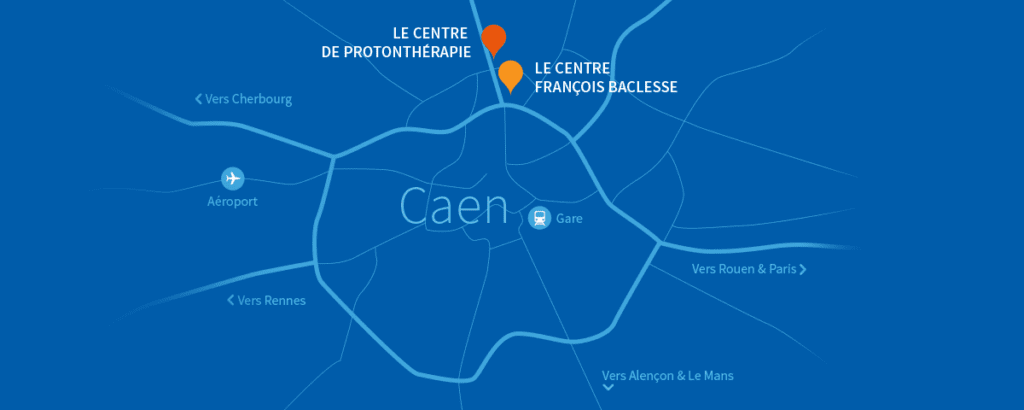
- Location: at the Proton Therapy Center, on the CYCLHAD site in Caen
For more information about a request for care, a stay or a treatment, please contact us.
The team
- Department Head: Dr Dinu STEFAN
- Health executive: Magali MICAUD
- Radiation oncologists :
- Dr BOUTER Jordan
- Dr LARNAUDIE Audrey
- Dr LELEU Thomas
- Dr MISSOHOU Fernand
- Dr RIVERAIN Jeanne
- Dr STEFAN Dinu
- Pr THARIAT Juliette
Professionals at your service
Your first contacts in the department will be the medical assistant, who will take your appointments, and the manipulator coordinator, who will organize your treatment and act as an intermediary with the team.
You will then meet the radiotherapist in charge of your treatment, and the manipulators who will take charge of your preparation and treatment sessions. The department is staffed by a multidisciplinary team who work closely together to do their utmost to welcome you, care for you, help you and answer your questions.
The Centre François Baclesse also offers a range of supportive care services that may be required alongside specific treatments (nutrition, pain management, psychology, etc.).
The reception team
Medical assistants and secretaries
They welcome you at the entrance to the Proton Therapy Center. They manage your monitoring appointments and medical correspondence, in collaboration with the radiotherapists.
The medical team
The radiation oncologist
This is the doctor who specializes in radiotherapy. He will define the areas to be irradiated and those to be protected, coordinate all your treatment, and ensure your tolerance to radiation during consultations.
The intern
He is a doctor in the process of specializing, working in conjunction with the radiation oncologist. He will also provide weekly follow-up consultations.
The paramedical team
The manipulators
The nursing staff welcome you every day. They take care of your positioning and carry out your treatment.
Pediatric coordinator
She guides young patients and their parents through their radiotherapy treatment. She answers patients' questions about the organization of their treatment and ensures coordination between professionals to optimize the quality of care.
The health executive
He is responsible for the care team and the organization of the technical facilities.
The dietician
It is involved in certain treatments, and in particular nutritional management, to help you maintain a constant weight.
The radiophysics team
The medical physicist
He is the guarantor of the smooth technical progress of your treatment. He ensures that doses are correctly distributed, in accordance with the medical prescription. They also take measurements on the equipment to check that it is working properly.
The dosimetrist
This is a technician entrusted by the medical physicist with the dose distribution study.
Service mission
Since August 2018 patients have been treated in Caen for their proton therapy treatment by the Radiotherapy department of the Centre François Baclesse at the Cyclhad site of the Normandy Proton Therapy Center.
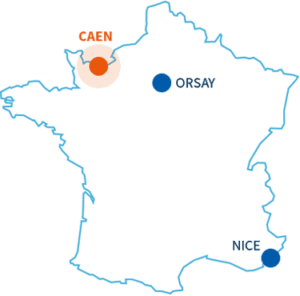
Proton therapy treatment at the Centre François Baclesse is a treatment option with a national dimension. It is the third site in France to offer this therapeutic modality, after the Orsay (Ile-de-France) and Nice centers. Given the scarcity of this type of facility in France, the Centre François Baclesse offers this therapeutic option, in coordination with other centers, to the French population.
Benefits of proton therapy
Proton therapy is an innovative technique for limiting the toxicity and improving the efficacy of certain photon-based radiotherapy treatments.
Conventional radiotherapy uses photon beams (X-rays). Proton therapy uses proton beams. The difference between proton therapy and conventional radiotherapy lies in the beam energy deposition method used. The deposition of proton beam energy enables the tumor to be treated without irradiating beyond this zone.
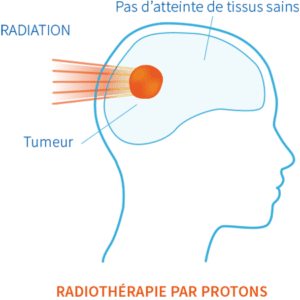
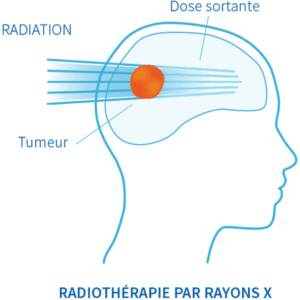
During radiotherapy treatment, healthy tissues in the vicinity of the tumor (critical organs) are bound to receive a certain dose, potentially generating side effects.
The physical properties of protons enable them to deliver their dose to the tumor without irradiating beyond it. As a result, proton therapy significantly reduces the dose of radiation to healthy tissues, with a consequent reduction in toxicity compared with the particles used in conventional radiotherapy.
Proton therapy can reduce both short- and long-term side effects. In particular, it reduces the likelihood of secondary tumors developing in patients treated during childhood and adolescence.
Proton therapy is used to treat cancer in patients for whom precise irradiation is even more critical than for conventional radiotherapy. This is the case for children with cancer, or adults with cancer located near critical, radiation-sensitive organs. Proton therapy is also indicated when conventional methods become too toxic and/or ineffective.
However, it is not suitable in all cases. Your treatment team will suggest the best radiotherapy technique for your individual case.
Care and Expertise
Adult cancers
For adults, proton therapy is currently indicated for tumors with high ballistic and radiobiological constraints. Some indications are currently consensual and validated by the French health authorities.
Radiation-resistant tumors are also indications for proton therapy, as they require high radiation doses to ensure tumor control, especially if they are close to organs with limited tolerance.
Indications are discussed on a case-by-case basis, based on a complete medical file and comparative dosimetry. The decision is validated by a specialized Multidisciplinary Consultation Meeting (RCP).
Cancers treated :
- Malignant cartilage tumors: chondrosarcomas, chordomas
- ENT tumors
- Tumors close to the spine, thoracic or abdominal tumors, not very mobile
- Tumors of the eye and orbit
- Curative re-irradiation
- Less aggressive brain tumors (meningiomas, paragangliomas also known as chemodectomas, neurinomas also known as schwannomas, craniopharyngiomas)...
Childhood cancers
Cancers treated :
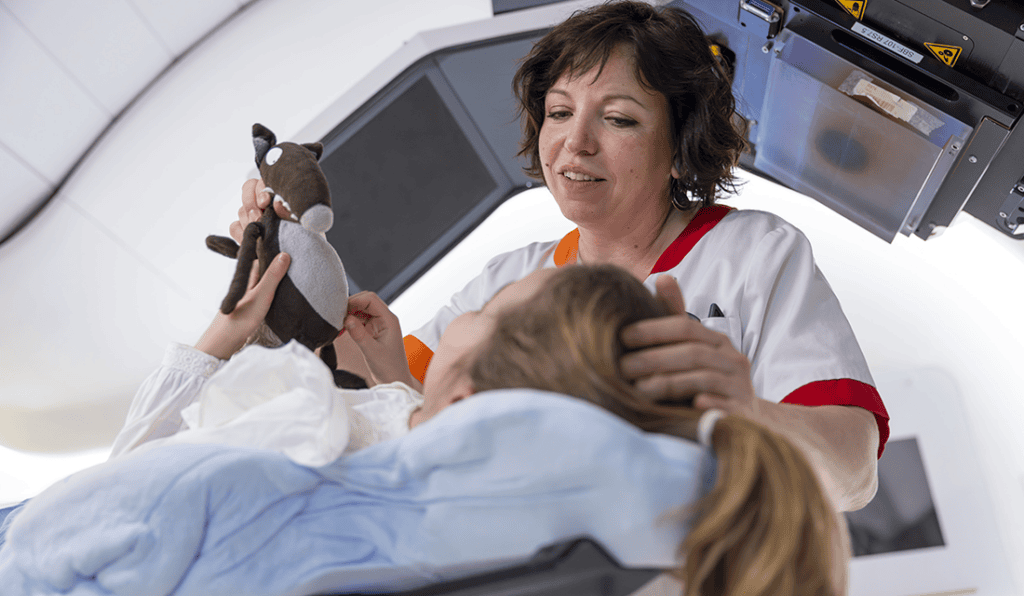
Thanks to its ballistic qualities, proton therapy exposes children to a much lower dose around the tumor than conventional photon radiotherapy. Its main advantages are the reduction of local, acute and late toxicities, functional sequelae (auditory, endocrine, cognitive) and very long-term carcinogenic risks.
Brain tumors :
- Medulloblastoma and other PNETs (Primitive Neuro Ectodermic Tumors),
- Gliomas
- Ependymomas
- Skull base tumor: Craniopharyngioma
- Soft tissue tumors: rhabdomyosarcomas (RMS), mesenchymal sarcomas
- Nervous system tumor: neuroblastoma
- Other pediatric tumors
Clinical research
Proton therapy is an innovative technique that generates less toxicity and is more effective than certain "conventional" photon radiotherapy treatments.
However, given the cost of proton therapy and the steady progress of conventional radiotherapy treatments, the indications for this new technique need to be justified and prioritized.
In this constantly evolving technological landscape, prospective work to analyze and demonstrate the advantages of proton therapy over photon therapy must therefore be carried out on an ongoing basis, in medical, societal and financial terms.
All patients treated with proton therapy are offered the opportunity to record their treatment and follow-up data in a secure database, shared with their referring radiotherapist.
Patients are also frequently invited to take part in a clinical research study as part of their proton therapy treatment, particularly for indications where the level of evidence needs to be strengthened.
Service equipment
On the Cyclhad website:
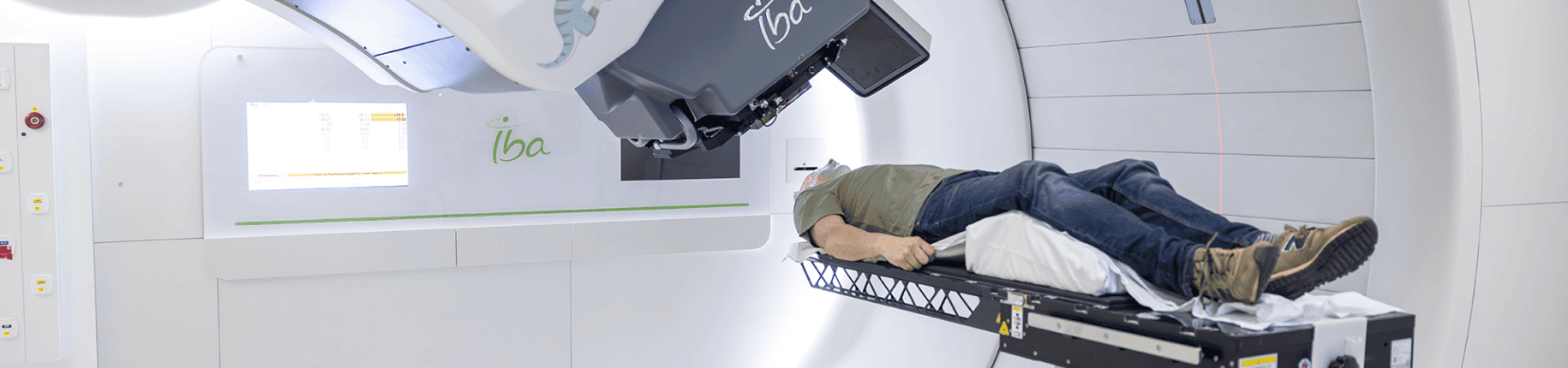
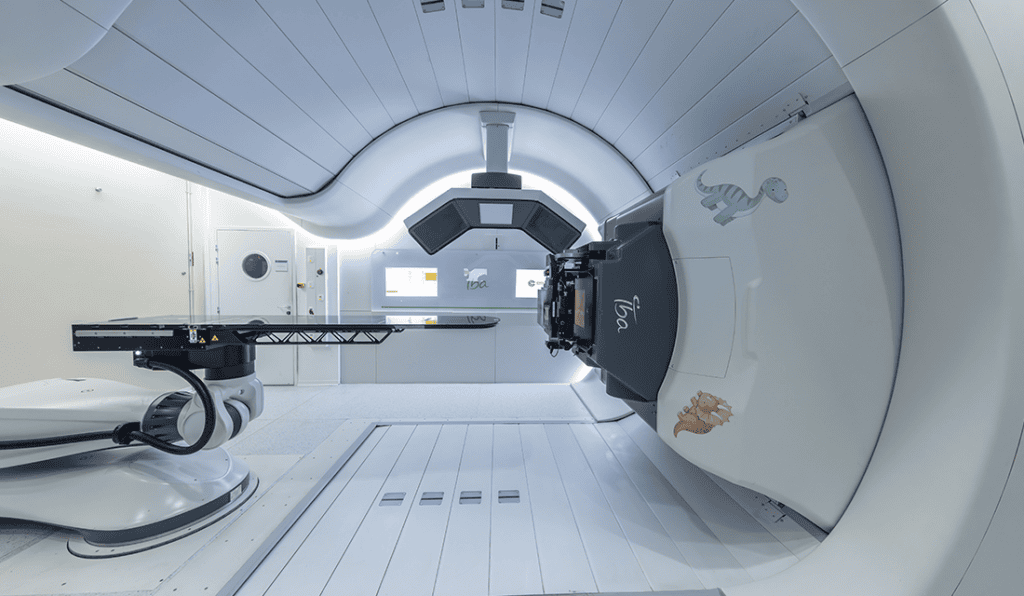
- Access to 1 Proteus One® proton therapy machine - IBA SA (2018)
The Centre François Baclesse uses Proteus One proton therapy equipment (IBA) featuring a gantry system with pencilbeam scanning (PBS), enabling conformal treatment with 3D modulation of the delivered dose.
Practical information
Hosting
Proton therapy treatment sessions take place on a daily basis over several weeks. Most patients are not hospitalized during this period. This means that patients who are geographically distant must find suitable accommodation. We can help you find suitable accommodation.
Most patients are not hospitalized during this period. Patients who are geographically distant must therefore find accommodation: we can help you in your search.
Accommodation is at your own expense. However, if you belong to a mutual insurance company, you may be able to apply for reimbursement of accommodation costs. Ask your health insurance company for details.
Accommodation is located in Caen or on the coast, a 20-minute drive away.
Depending on your needs, we can refer you to a standard hotel, service residence or apartment hotel.
The Centre François Baclesse has agreements with accommodation providers giving access to preferential rates for Centre patients:
- DOMYTIS
Temporary accommodation in Caen, Cabourg, Dives-sur-Mer, Bayeux, Courseulles-sur-Mer
Contact: Charlotte VALLÉE : 07 61 75 12 98
For more information about arranging accommodation, contact the Proton Therapy department: 02 31 24 34 48
Access
Initial treatment takes place at the Centre François Baclesse. Proton therapy treatment sessions take place at the Centre de Protonthérapie, a 5-minute drive from the Centre François Baclesse.