
Your oncologist has told you that you have thyroid cancer. This information will help you better understand your treatment.
What is thyroid cancer?
Thyroid cancer is a disease of the thyroid cells. The disease starts with a normal cell that develops abnormalities. This cell multiplies with these abnormalities until it forms a tumor.
Thyroid cancer often appears as a nodule (a mass). The disease may be discovered on an imaging scan, by palpation of the neck, or by discomfort in the neck or voice.
Depending on how advanced the disease is, we speak of :
- Localized cancer: when the tumor remains in the thyroid gland
- Locally advanced cancer: when the tumor begins to affect the periphery of the thyroid ;
- Lymph node cancer: when the lymph nodes in the thyroid region are affected,
- Metastatic cancer: when the cancer has spread to other organs away from the thyroid (e.g. lungs, bones, liver).
The whole process takes several years.
- Note: 95% of nodules discovered are benign..
What does the thyroid do?
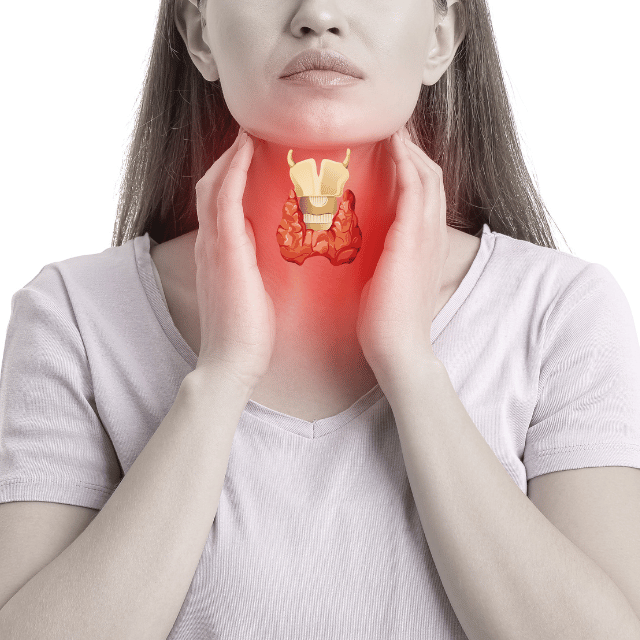
The thyroid is an organ located at the front of the neck. It consists of two lobes, right and left, joined at the center. The thyroid is an endocrine gland, producing hormones that act as messengers capable of ordering actions at a distance from the thyroid.
These hormones influence the production of energy and heat, as well as the utilization of nutrients.
How is the diagnosis made?
When a thyroid nodule is discovered, the patient is asked about his or her personal and family history.
Complementary examinations are also carried out:
- Clinical examination
- A blood test
- Imaging tests
These tests are used to assess the risk of cancer.
Depending on the results, cells may be removed for cytological examination. In some cases, cancer is diagnosed after a surgical operation (e.g., to remove an apparently benign mass or a malignant nodule). The area removed during this operation is subjected to anatomopathological examination. It is during this examination that the cancer may be discovered.
What treatments are available?
Several treatment options are available, depending on age, general condition and the extent and aggressiveness of the disease. Treatment options are discussed at a multidisciplinary consultation meeting (RCP ), which brings together several professionals (nuclear medicine physicians, endocrinologists, surgeons, oncologists, radiotherapists, etc.) to propose the most appropriate treatment, with the possibility of several treatment modalities.
The proposed treatments are described in a document called the Personalized Care Program (PPS).
Surgery
Surgery is frequently used to treat thyroid nodules, whether benign or malignant (thyroid cancer). It is performed under general anaesthetic. In most cases, the entire thyroid is removed(total thyroidectomy). In some cases, a single lobe of the thyroid is removed(lobectomy). This procedure is performed in the surgical department of the Centre Baclesse.
After a total thyroidectomy, the surgeon may need to remove lymph nodes located close to the operated area (lymph node curage).
- Note: thyroid ablation requires lifelong hormone treatment.
Radioactive iodine treatment
Treatment with radioactive iodine or iratherapy (iodine 131) is a specific type of internal vectorized radiotherapy for the treatment of follicular thyroid cancer. This treatment is carried out by the Nuclear Medicine department. It can be scheduled in the first few months after surgery. This treatment is only administered in the event of total thyroid ablation. Normally, the treatment is administered only once, but in some cases it may be repeated.
This treatment comes in capsule form. Radioactive iodine is used to destroy thyroid tumor cells.
In most cases, this treatment requires hospitalization in an area protected from radioactivity. A few days after treatment, a scintigraphy is performed to visualize the parts of the body to which the iodine has attached itself. The patient's return home is subject to radiation protection instructions. These instructions are issued by the care team.
- Please note: Iratherapy is contraindicated in the event of breast-feeding or pregnancy. On the other hand, contraception is required before starting treatment and must be continued for 12 months after the end of treatment.
The nuclear medicine department at the Centre Baclesse, headed by Dr Stéphane BARDET, is involved in the management of benign and malignant thyroid diseases.
Treatment of refractory thyroid cancer
Locally advanced or metastatic thyroid cancers that are resistant to standard treatment are referred to as "refractory thyroid cancers."
In these situations, what are the treatments?
Levothyroxine replacement therapy
After total thyroidectomy, synthetic thyroid hormones are taken daily in tablet form. This treatment replaces the natural hormones normally produced by the thyroid gland prior to removal, and must be taken for life.
This treatment requires regular follow-up. It can be adapted over time, for example in the event of pregnancy.
Daily life with thyroid cancer
Supportive oncology care
Supportive oncology care refers to all approaches or treatments that help you to tolerate treatment better and live through the difficult situation you are experiencing.
REMINDER
The Espace de Rencontres et d'Information (ERI) at the Centre Baclesse is at your disposal and can direct you to help and support associations.