
Your oncologist has told you that you have a tumor of the central nervous system or brain tumor. This information will help you better understand your care.
What is a brain tumor?
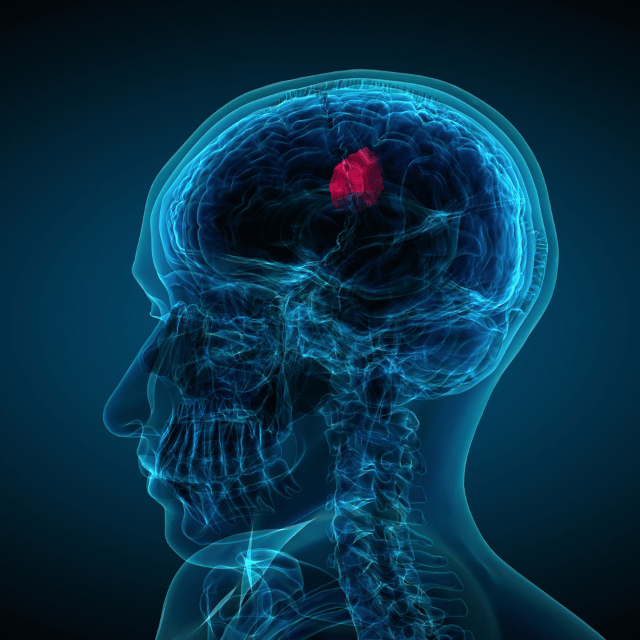
Brain tumors are a heterogeneous group of malignant tumors that can affect the brain, spinal cord or other parts of the central nervous system.
Malignant brain tumours include :
- Low-grade gliomas
- High-grade gliomas (including glioblastomas)
- Meningiomas
- Pituitary tumors
- Ependymomas
- Primary germ cell tumors of the central nervous system
- Other rarer tumors
Initial treatment is carried out in neurosurgery, with a biopsy or the most extensive surgery possible to establish the diagnosis. Patients are then taken to the Centre Baclesse for further treatment: radiotherapy, chemotherapy, targeted therapy, TTFields (a device that delivers electric fields), etc.
The Centre Baclesse offers comprehensive care with a care path adapted to the pathology and the patient. Several players are involved in the care process: radiotherapist, medical oncologist, nurse, support care team, social worker, psychologist, etc. The patient's referring doctor may also suggest participation in clinical trials with new radiotherapy techniques or new treatments. The patient's referring physician may also suggest participation in clinical trials involving new radiotherapy techniques or drugs.
What treatments are available?
Management of brain tumors is decided collegially (Neurosurgeon, Medical Oncologist, Radiation Therapist, Radiologist, Anatomopathologist). The Multidisciplinary Consultation Meeting (RCP ) is held every two weeks. Several types of treatment may be considered, alone or in combination: surgery, radiotherapy, chemotherapy or targeted therapy.
Surgery
Whenever possible, surgery is the first-line treatment. It aims to remove all or part of a tumor, and to establish a diagnosis of histological and molecular certainty. Surgery is performed in other hospitals as part of a coordinated treatment program. In some cases, additional post-operative treatment (radiotherapy and/or chemotherapy) is indicated to limit the risk of recurrence.
Radiotherapy
Radiotherapy consists in destroying the tumor using radiation. A simulation session is first required to define the area to be irradiated. Several daily treatment sessions are required. Treatment can last up to 6 consecutive weeks. It is performed on an outpatient basis.
Radiotherapy is now extremely precise, enabling us to spare healthy tissue more effectively by targeting the areas to be irradiated. The Centre Baclesse uses the most innovative techniques in cerebral radiotherapy (tomotherapy, VMAT, Cyberknife stereotactic radiotherapy, etc.).
Depending on the type of tumor, proton therapy may be indicated. Proton therapy is a type of radiotherapy that uses protons as an energy source. All patients undergoing radiotherapy are offered a weekly consultation with a doctor. This follow-up appointment enables us to discuss the treatment with the patient, assess any side effects and adapt the treatment if necessary.
Chemotherapy
There are various molecules, which can be used alone or in combination.
- For oral chemotherapy: patients take their treatment by tablet at home.
- For infusion chemotherapy: an implantable chamber will generally be indicated, and the patient will be admitted to a weekday or day hospital, depending on whether or not his or her protocol requires sleeping in hospital during administration.
To provide the best possible support for patients taking oral therapies, the Centre Baclesse has set up a tripartite consultation at their initiation. The patient is greeted by an oncologist, a pharmacist and a neuro-oncology nurse, in order to offer comprehensive care and limit the risk of drug interactions. For certain brain tumors, an innovative device (OPTUNE) is recommended in association with chemotherapy. The patient will be received at the Center for a day hospitalization dedicated to the presentation of the device, as well as to his or her loved ones.
Targeted therapy
For certain brain tumors, the patient may receive one or more molecules targeting specific features of the tumor, thereby improving management and reducing side effects. Examples include anti-angiogenic drugs, which block the formation of new vessels that feed the tumor, or therapies targeting a specific gene mutation.
Clinical trials
For certain pathologies and for specific indications, the neuro-oncology team may suggest that you take part in a clinical trial at the Centre Baclesse or in another institution, in order to gain access to innovative treatments.
Personalized nursing care
At the Centre Baclesse, a support nurse provides personalized follow-up throughout the care process. She assesses needs, provides information, advice, support and guidance.
Her main responsibilities are to :
- Complete the information given by the referring doctor.
- Offer access to the Center's supportive care services.
- Communicate with the various professionals at the Centre Baclesse, but also in the region, to facilitate care.
In practice, she is involved right from the start of treatment. Support interviews are scheduled at key points in the treatment process: before and during chemotherapy, before radiotherapy, and at the end of treatment.
- Telephone helpline: 02 31 45 40 71 Monday to Friday, 9.30am to 11.30am.
- Location: The Neuro-oncology pathway nurses' offices are on the 6th floor.
Supportive care
Supportive care is the care and support required by patients throughout the course of their disease, in conjunction with specific oncology treatments where available. It is an integral part of treatment, designed to improve quality of life.
The support care department at the Centre Baclesse comprises a consultation service, a scheduled hospitalization service on the 4th floor and an ambulatory medicine service on the 3rd floor (CEMAB).
REMINDER
The Espace de Rencontres et d'Information (ERI) at the Centre Baclesse is at your disposal and can direct you to help and support associations.
Request for a second medical opinion
If you wish to request a second medical opinion, please send us the following information:
- Patient details: Last name, first name, postal address, telephone number and e-mail address.
- Details of the doctor making the request: Surname, first name, postal address and e-mail address. The medical opinion will be sent to this doctor.
- Medical summary letter
- Complete medical file: last RCP form, histological report (diagnosis), report on last brain scan.
- If treatment has been started, the nature of this treatment: molecule, dosage, frequency of administration, start date
- Identity of the person requesting the opinion: If you are the patient, the referring physician or the attending physician
These items should be sent :
- by e-mail to: ORANGE@baclesse.unicancer.fr OR
- by post to the following address:
Centre François Baclesse
Secrétariat secteur Orange
3 avenue Général Harris
14000 CAEN
In all cases, also send by post: the MRI or CT scan CD-Rom.
- Incomplete applications will not be processed.