A scientific paper published on November 9, 2026, in the journal *Frontiers in Nuclear Medicine* demonstrates the value of personalized 3D dosimetry for better assessing the consequences of extravasation during treatment with Lutathera® (¹⁷⁷Lu-DOTATATE).
This research is part of Simon Lechien’s doctoral thesis, co-supervised by GANIL and the Department of Medical Physics at the François Baclesse Center. It was conducted as part of the OPTADOM project, funded by Inserm under the Decade-Long Strategy to Combat Cancer, in collaboration with the ASNR.
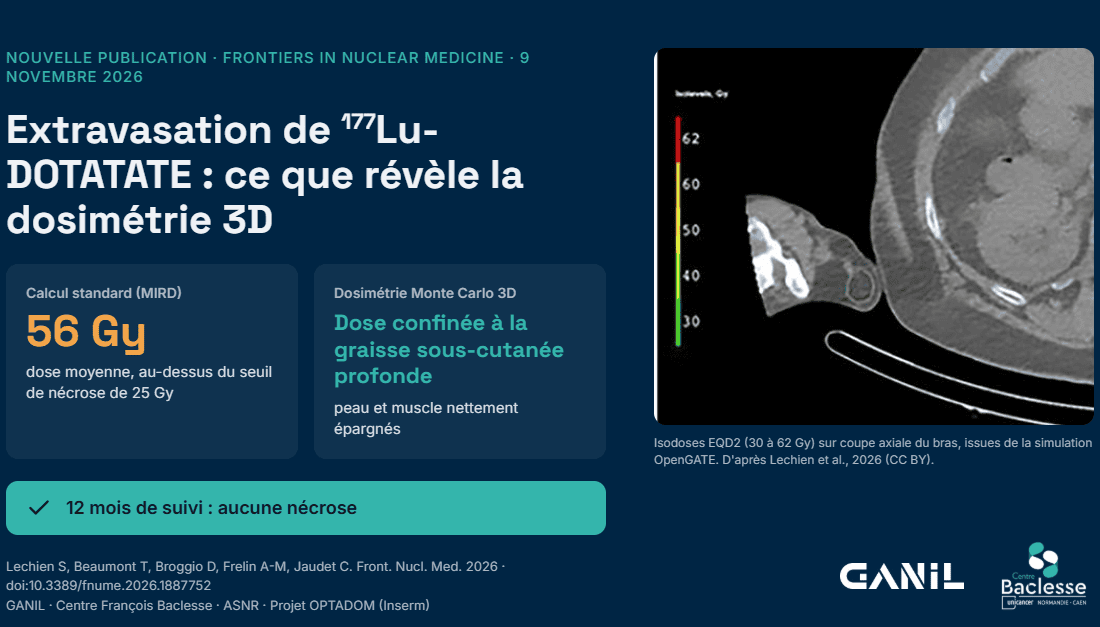
The study involved a patient who experienced an extravasation of approximately 2.7 GBq in her arm. Standard dosimetric calculations estimated an average dose of 56 Gy, which is higher than the threshold typically associated with a risk of necrosis (25 Gy). Personalized 3D dosimetry was performed using Monte Carlo simulation based on TEMP-CT images. It confirmed this order of magnitude, while showing that the dose was primarily concentrated in deep adipose tissue, with the skin and muscle being significantly less exposed.
After 12 months of follow-up, no necrosis was observed; only transient erythema was noted.
This study highlights the importance of considering the distribution of the dose within tissues, beyond just its average value. It also demonstrates the effectiveness and expertise of the Baclesse nuclear medicine team. The extravasation was detected within the first few minutes of the injection; treatment was initiated immediately, and the medical physics team was alerted without delay. Subsequent imaging follow-up then enabled this in-depth dosimetric analysis.