
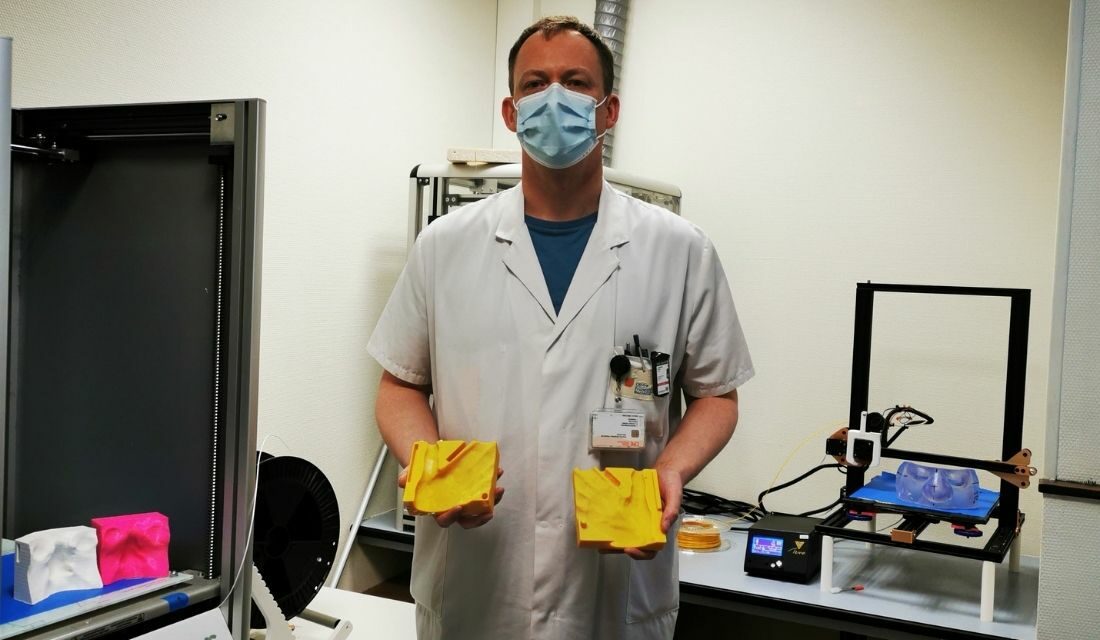
The "H3DMED" research project, led by the Centre François Baclesse, has just been awarded €246,000 in ERDF funding as part of the Normandy region's "Data and associated technologies, applied to healthcare" call for projects. Carried out in partnership with Evanov (Caen), this project aims to facilitate the design and commissioning of personalized brachytherapy applicators using artificial intelligence and 3D printing.
Call for projects: "Data and related technologies applied to health"
Co-financed by the European Union and the Normandy Region within the framework of the European Regional Development Fund (ERDF), this call for projects provides financial assistance to the winners, as well as the expertise of DataLab Normandie and the Health Data Hub, notably for the acquisition of databases and the allocation of a digital project space.

The projects started in June 2021 and will be completed by September/October 2022 at the latest.
What is personalized brachytherapy?
For over 30 years, the François Baclesse Center has specialized in personalized brachytherapy. This radiotherapy technique involves irradiating tumors using radioactive sources that are positioned in close proximity to the area to be treated using resin guides called "applicators."
The positioning of the radioactive source (called "dose paths") is calculated using a densitometric scan of the patient and dosimetry software (called TPS).
Example of application to a tumor located around the left thumb:
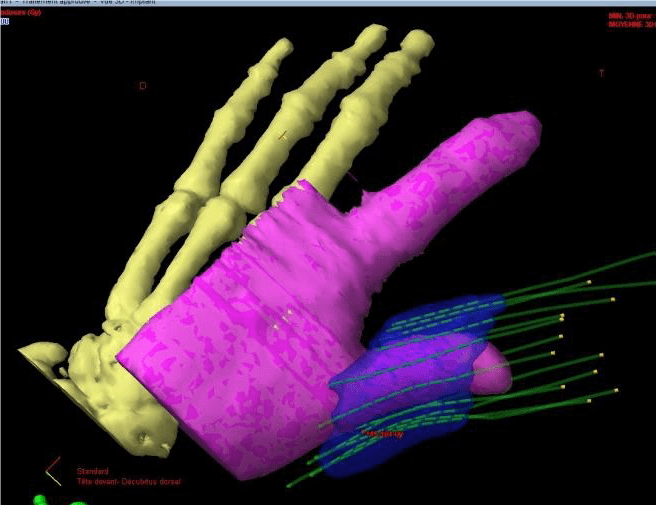
Green: Dose paths
What is the aim of the "H3DMED" research project?
Cédric LOISEAU (medical physicist in brachytherapy at the Centre François Baclesse) is in charge of the H3DMED project, which uses artificial intelligence and 3D printing to facilitate the design and commissioning of customized brachytherapy applicators.
A primary objective of the "H3DMED" project will be to develop an artificial intelligence component that will facilitate the design of applicators for more precise brachytherapy treatments:
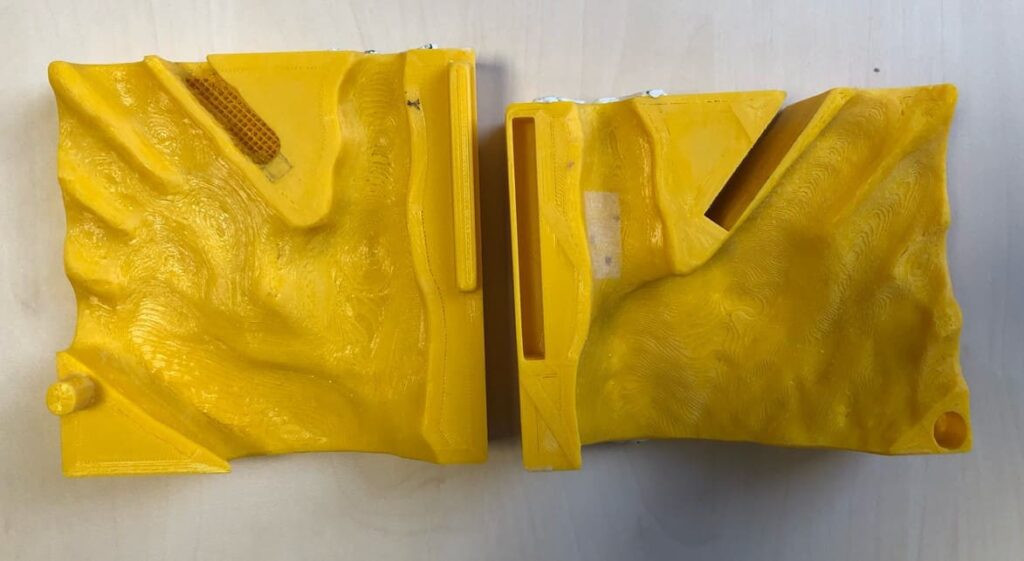
Historically, the "applicators" that guide the radioactive source have been developed by molding the anatomy of the patient to be treated. These resin applicators are designed to guide the effective dose as close as possible to the tumor while preserving the surrounding tissue. However, their implementation remains a manual and time-consuming process. This technique can be optimized using artificial intelligence and 3D printing:
- Artificial intelligence will automatically suggest dose paths to the medical physicist, saving him days of simulation.
- 3D printing will make it possible to precisely manufacture customized applicators that faithfully reproduce dose paths.
A second objective of the "H3DMED" project will be to develop a second artificial intelligence component that will facilitate the literature reviews required for the clinical evaluation of 3D-printed medical devices within a healthcare facility.
Who's involved in the project?
EVANOV (Caen), a partner in the H3DMED project, supports innovative healthcare projects by providing its expertise in the development of medical devices (R&D, quality and regulatory).
LITIS (Rouen) advises the H3DMED project. The Laboratoire d'Informatique du Traitement de l'Information et des Systèmes (LITIS) is an information science and technology research unit attached to the Université de Rouen Normandie (URN), the Université Le Havre Normandie (ULHN) and the Institut National des Sciences Appliquées de Rouen Normandie (INSARN).

Momenttech (Caen), a software publisher specializing in artificial intelligence, is taking part in the research and development work.
What are the expected results?
The artificial intelligence technologies developed by this project will improve brachytherapy patient care through personalized medicine. Subsequently, the Centre François Baclesse and EVANOV plan to join forces in the future startup H3DMED, whose mission will be to develop artificial intelligence solutions to facilitate the use of 3D printing in healthcare establishments.