

It's time for the flu vaccination campaign. This is an opportunity to take stock of certain questions and preconceived ideas. Interview with Dr Anne CANIVET, hygienist and coordinator of healthcare risk management at the Centre François Baclesse.
Why get vaccinated against the flu? We've already got masks and we're putting in place barrier measures...
As every year, flu vaccination is recommended for healthcare professionals, and more generally for professionals working in healthcare establishments, for individual protection (being bedridden and "at the end of your tether" because of the flu is a bit of a bummer...) but above all for the collective protection of patients.
It has been clearly demonstrated, for example, in EHPADs that the elderly, who have less effective immune systems, are less affected by influenza when caregivers are vaccinated than when they are not. The same applies to CLCCs, where many patients are immunocompromised.
Barrier measures are still theoretically recommended in our daily lives. It's thanks to them that there were no cases of influenza in France last year: the whole population applied these measures very well, and they proved their effectiveness.
But this year, the flu virus has already started circulating, along with bronchiolitis and measles, ahead of the usual "pre-Covid" schedule.
Astrid Vabret, head of the virology department at CHU, explains that "for the past 20 months, organisms have not encountered these viruses, and immune defenses have weakened. (...) We fear an influx of patients this winter who will saturate the hospitals" (see Ouest-France interview, 12/10/2021).
From the hygienist's point of view, this can also be explained by a less effective application of barrier gestures. While masks are still compulsory in places where the sanitary pass is not, hand hygiene is hardly ever applied as a barrier between different places. Just stand at the entrance to a supermarket and observe how many people do or don't perform hand hygiene before entering. Or on arrival at the Center: hand hygiene is always performed during care, but many of us no longer take SHA when we sign in.
And despite the mask, last year we saw clusters of Covid-19 in a number of departments, affecting both caregivers and patients, even though the mask was being worn throughout the facility. The chains of transmission were linked either to shared moments of conviviality (breaks, meals, evenings), or to imperfections in mask wearing (hand hygiene every time I handle my mask, optimal mask adjustment...).
For all these reasons, we can fear a major circulation of the flu virus, and in addition to barrier measures, it's important to get vaccinated, to protect our patients.
Are there any side effects to the vaccine?
Like all medicines, vaccines can have side effects. As always, the benefit-risk ratio is assessed during pre-marketing studies: when a vaccine is put on the market, it's because its benefits are judged to far outweigh the possible risks.
And it continues to be monitored very closely afterwards, thanks to what's known as pharmacovigilance: any healthcare professional or individual can report an event they believe to be linked to taking a medicine. These events are analyzed in relation to the scientific literature on the subject, and an "imputability study" is carried out, to assess whether the link can be proven or is merely due to chance (to give an extreme example, just because a person has a road accident in the hours following vaccination does not mean that the accident is a side effect of the vaccine...).
The most common side effects of known vaccines are transient injection-site pain and fever. Fatigue, headaches and, more rarely, flu-like symptoms (but not flu-like - see below - and lasting much less time) can also occur. If you experience these types of effects when you are vaccinated, taking paracetamol during the symptoms will help to alleviate them.
In the event of more serious side-effects, consult a doctor.
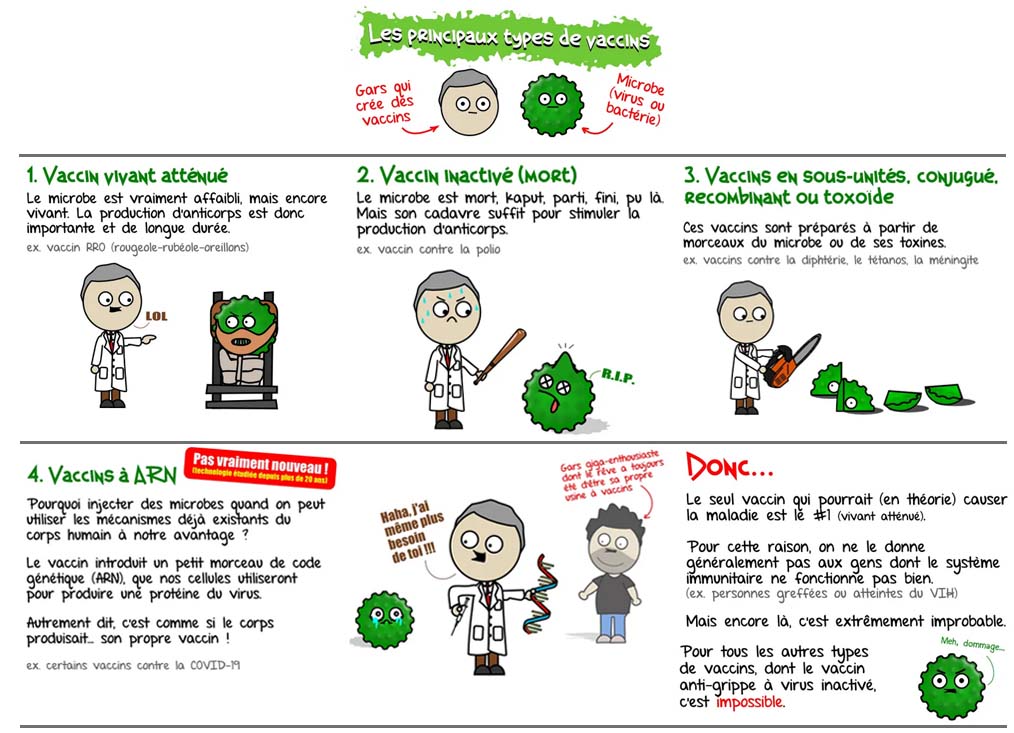
One year, I got vaccinated, and it gave me the flu!
A vaccine contains a harmless version of a microbe to produce the same effect.
This can be done in different ways:
The vaccine is not effective!
Vaccine efficacy depends, first and foremost, on the age and state of health of the person vaccinated, as well as the time elapsed since vaccination (the launch date of the vaccination campaign is thus set according to what has been observed in previous years, so as to enable vaccination before the arrival of the epidemic, but also not too early to preserve vaccine efficacy for as long as possible).
Efficacy also depends on the degree of concordance between the vaccine's composition and the viruses circulating at the time of the epidemic.
Each year, the composition of the vaccine manufactured is based on the viruses that circulated during the southern hemisphere winter season, in order to be as close as possible to what we may see coming. However, viruses have the capacity to mutate: mutations cannot be predicted, and neither can the effectiveness of vaccines at the time of an epidemic. Fortunately, it is rare for vaccine efficacy to be completely wiped out by virus mutations.
The WHO estimates that vaccines prevent an average of 60% of infections in adults aged 18 to 64.
A final word on efficacy: the vaccine is only effective for around 2 weeks after vaccination.
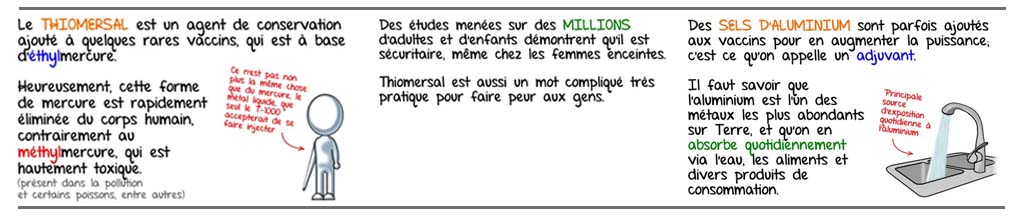
Vaccines contain aluminum and mercury!
And if I want to be vaccinated against influenza and Covid, what happens?
There is no specific delay between the Covid and influenza vaccines.
The only recommendation is that, if both are given at the same time, each should be given in a different arm.
In conclusion...
- Wherever you like,
- By whomever you choose (doctor, nurse, pharmacist, midwife),
- Get your flu shot!