
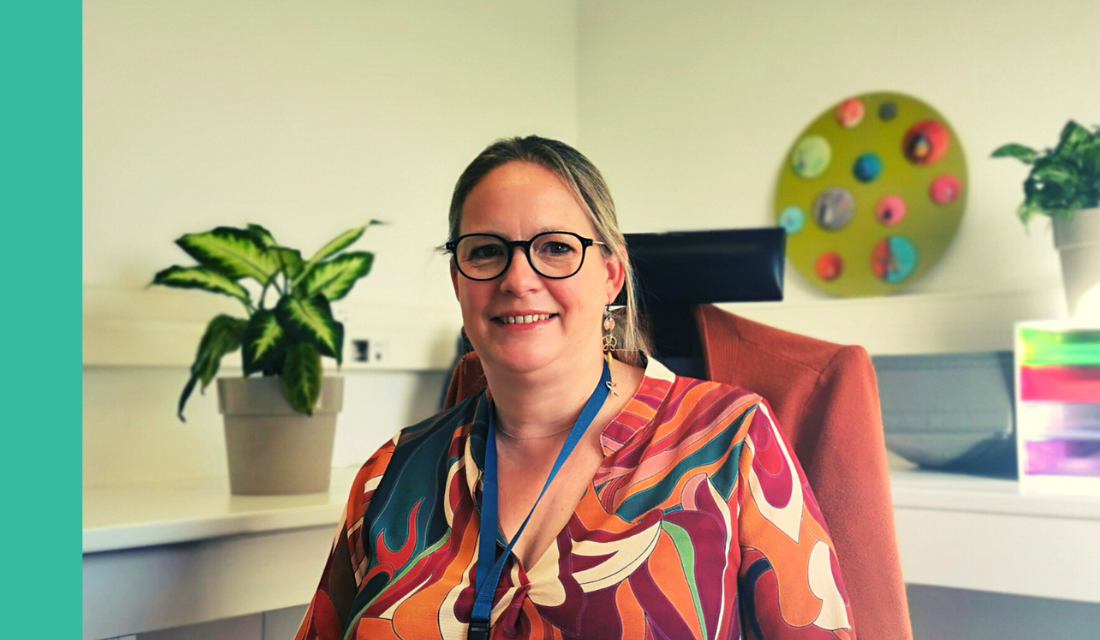
Meet Sylvie Chevigné-Drouguet, who has just been hired by the Center as a "Patient Partner." This is a brand new position. We'll let her introduce herself...
What is a patient partner?
When a patient suffers from cancer or a chronic illness, he or she acquires knowledge about daily life with the disease and its treatments. The patient partner has decided to share his knowledge and experience with other patients who also suffer from a chronic illness, as well as with caregivers who want to see the disease from the perspective of the person living with it.
Why did I become a patient partner?
A few years ago, the doctors diagnosed me with two cancers, one of which would become a chronic illness that I would have to learn to live with.
During my first treatments, I felt a lack of being able to ask questions to someone who had already been through it and who could have explained the examinations, treatments and their side effects to me, not in a theoretical way but in a personal way. I would also have liked to talk to this person about the difficulties I was encountering in my daily life with the disease, about fatigue, stress...
When the first treatments came to an end, I wondered if, at my level, I could help people with cancer get through the ordeal by taking on the role of companion that I had missed out on. I looked into what already existed and discovered several training possibilities, including the Université des Patients at the Sorbonne, which offered a D.U. in "Patient référent en cancérologie". I sent in my application and it was accepted.
How did I become a patient partner at Baclesse?
During my year of study, I had the opportunity to observe several patient journeys at the Centre François Baclesse. Last March, I learned of the opening for a patient partner position at the Centre and applied.
What are my responsibilities at the Centre?
My primary mission at the Centre François Baclesse is to support patients who so wish. It must be stressed that this is peer support, not psychological support, and that I am in no way qualified to answer medical questions. More often than not, patients ask me questions about the side-effects of treatment in their daily lives, as well as tips on how to cope better with them, how examinations, chemotherapy and radiotherapy go... They share their fears, and sometimes also express themselves more fully about their experiences with the disease or the problems they encounter, since I'm not a carer. When necessary, I pass on their questions to the care team or direct them to the person who can help them.
This support can also take place after the treatment period, when the patient is wondering how to get back to "life as it was", when he or she may have lost their bearings and feel out of step with their pre-disease habits.
My second mission is to support interested teams in their projects. My point of view as a patient can complement theirs, and draw their attention to elements that you can only appreciate if you've been through the care process yourself. Since my arrival, I've already been asked to work on a number of different projects.
Other missions will no doubt be added in the future.