
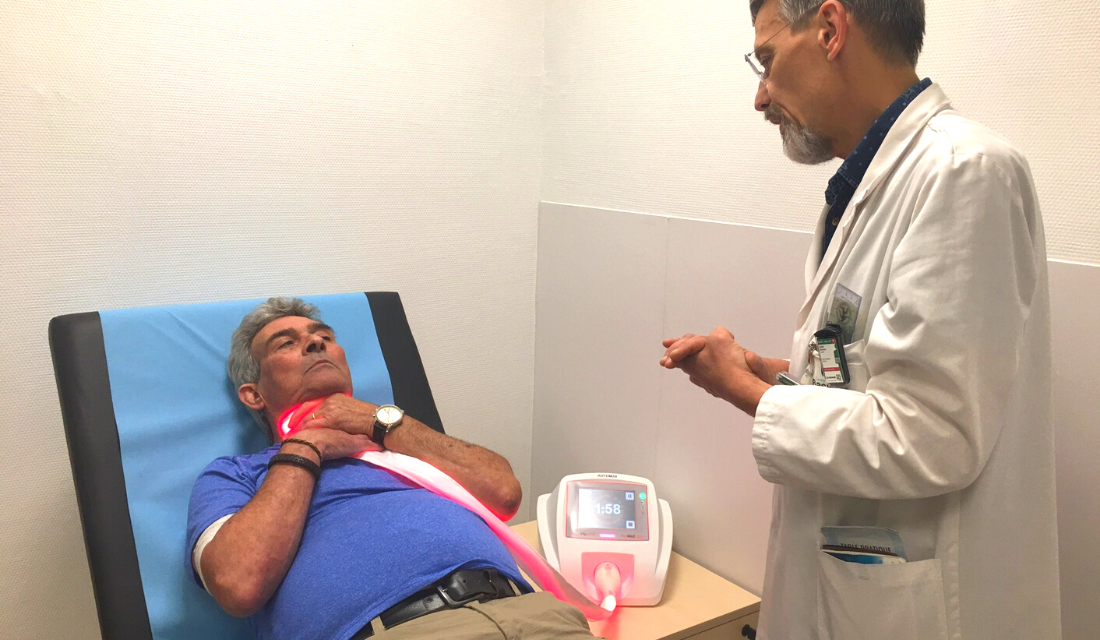
On July 10, 2023, the Centre François Baclesse carried out the first photobiomodulation session for an ENT patient at the start of irradiation.
What is supportive care?
Oncology support care encompasses all the care and support required by patients throughout their illness. The main aim of this care is not only quality of life, but also survival.
An institutional priority at the Centre François Baclesse for 50 years, supportive care is constantly evolving to meet the needs of patients and their caregivers, and to keep pace with changes in cancer treatments and their potential side effects.
Supportive oncology care is an integral part of patient care.
What is photobiomodulation?
Photobiomodulation is a non-invasive, painless and heatless technique.
It uses red light (or near-infrared light) from different types of emitting sources (laser or LED).
The light energy transmitted to the cells has various effects: analgesic, anti-inflammatory and healing.
Indications for oncology treatment
In oncology, photobiomodulation is now included in the recommendations of several learned societies, including ESMO (European Society of Medical Oncology) and MASCC (Multinational Association of Supportive Care in Cancer), as part of the prevention and treatment of mucositis in patients treated with radiotherapy or radiochemotherapy for ENT cancer, and during bone marrow transplants in haematology.
Depending on the case, photobiomodulation can be applied as a preventive or curative measure. It reduces the side effects of treatment, such as :
- radiodermatitis: reaction affecting the skin;
- Mucositis: more or less painful inflammation of the mucous membrane of the mouth;
- certain types of pain.
Thanks to this technique, the reduction in the frequency and intensity of these side effects is associated with better tolerance of irradiation, a reduction in the prescription of analgesic drugs and artificial nutrition, a reduction in the number of hospitalizations during irradiation, and overall, an improvement in quality of life.
Photobiomodulation is also currently being studied in other indications, for which it seems very promising:
- Trismus (limitation of mouth opening) ;
- Osteo chemo necrosis and osteoradionecrosis (complication of chemo or radiotherapy linked to a healing defect in the bone tissue of the jaw);
- Hand-foot syndrome associated with certain types of chemotherapy;
- Dry mouth;
- Helps heal wounds...
The equipment
This first photobiomodulation equipment has been installed in the Radiotherapy Department of the Centre François Baclesse. The CareMin650 (NéoMedLight) device features a red LED light generator, which is transmitted via optical fibers and then emitted onto the surface of applicators: small ones placed in the mouth to treat mucositis, or larger ones positioned directly on the skin opposite irradiated areas to treat skin reactions.
Eligible patients
Initially, ENT patients with tumors of the oral cavity or oropharynx will benefit from this new technology, which will then be extended to other tumor types.
Session sequence
Sessions are carried out on a seated or lying patient, in no particular chronological order in relation to the irradiation session itself; they begin on the first day of treatment as a preventive measure, and treatment parameters are adapted according to the intensity of cutaneous or mucosal reactions observed.
Each session lasts around ten minutes, and includes time to treat the mucous membrane of the mouth and time to treat the skin. To achieve the desired effect, it is necessary to carry out three to five sessions each week of irradiation, and possibly a few sessions afterwards, depending on the intensity of reactions at the end of treatment.
A project made possible by donations
This project, costing over €10,000, was funded thanks to donations of €6,500 from the association "Vagues de Nacre" and €3,000 from the association "Les Julouvillaises." Many thanks for their help!
By 2024, we also plan to equip the Center's Support Care department with another, more versatile photobiomodulation device, whose different characteristics will enable us to open up this technique to other indications, as knowledge evolves.