
While cancer treatments have been available in Caen for almost 100 years - the first patient was treated with radiotherapy on the premises of the former Clémenceau hospital in 1925 - the current building of the Centre Baclesse dates back to 1973. It was inaugurated by Pr Jacques-Séverin ABBATUCCI, director of the Center for 18 years (1970-1988), in the presence of the French Minister of Health, Simone VEIL.
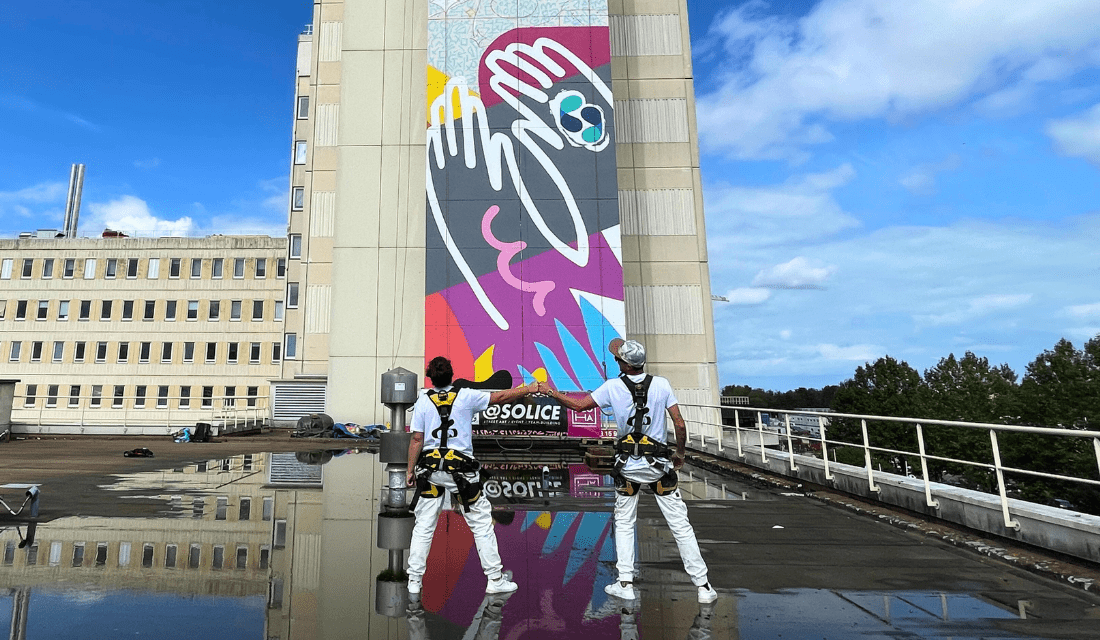
To mark the building's 50th anniversary, a giant fresco is being painted on the south facade by Caen artist SoLiCe. It is the tallest fresco in Normandy. The fresco is intended to reflect Baclesse's values and missions, as defined by patients and healthcare professionals.
In fact, 2 working groups met to define the themes to be featured on the fresco: a group of patients, and another with healthcare professionals. The groups came up with clouds of key words. The Centre Baclesse submitted these expressions to all employees via an electronic vote (1,200 people).
The following keywords were selected:
- Support / solidarity / humanism
- Research (healing)
- Fighting
- Caring / listening
- Hope / Renewal / Rebirth
A few technical details about the fresco:
- The fresco measures 27 m x 5 m
- The maximum height of the building is 32 m
This anniversary is also an opportunity to pay tribute to Professor Abbatucci
Professor Jacques-Séverin ABBATUCCI headed the Centre Baclesse from 1970 to 1988. He passed away in 2020, during a period of confinement. Those who knew him well in Caen remember him as a man of great modernity and high vision.
To pay tribute to him, the Baclesse amphitheatre, which welcomes students as well as doctors and experts from all over the world for conferences on cancer, will be renamed the " Abbatucci Amphitheatre ". A commemorative plaque will be unveiled on September 14.
A visionary, the Centre Baclesse owes a debt of gratitude to Professor Abbatucci for the medical organization of multidisciplinary committees, which would become mandatory in oncology 30 years later. He was also the driving force behind a policy of comprehensive patient care, with the creation of support services as early as 1975: social services, dietetics, speech therapy, a mobile palliative care and pain team, etc. His passion for innovation naturally led him to invest early in the field of information technology, enabling the Centre François Baclesse to be one of the first hospitals to computerize a shared medical file, as early as 1985!
He is the father of our current values: Humanism, Excellence, Innovation, Solidarity.