
Your oncologist has told you that you have prostate cancer. This information will help you better understand your treatment.
What is prostate cancer?
Prostate cancer develops from normal prostate cells, which transform and multiply anarchically, forming a mass called a malignant tumor that evolves over time.
Depending on how advanced the disease is, we speak of :
- Localized cancer: when the tumor remains in the prostate,
- Locally advanced cancer: when the tumour extends beyond the prostate into adjacent organs.
- Metastatic cancer: when the cancer has spread to other organs away from the prostate (e.g. bone or liver).
What role does the prostate play?
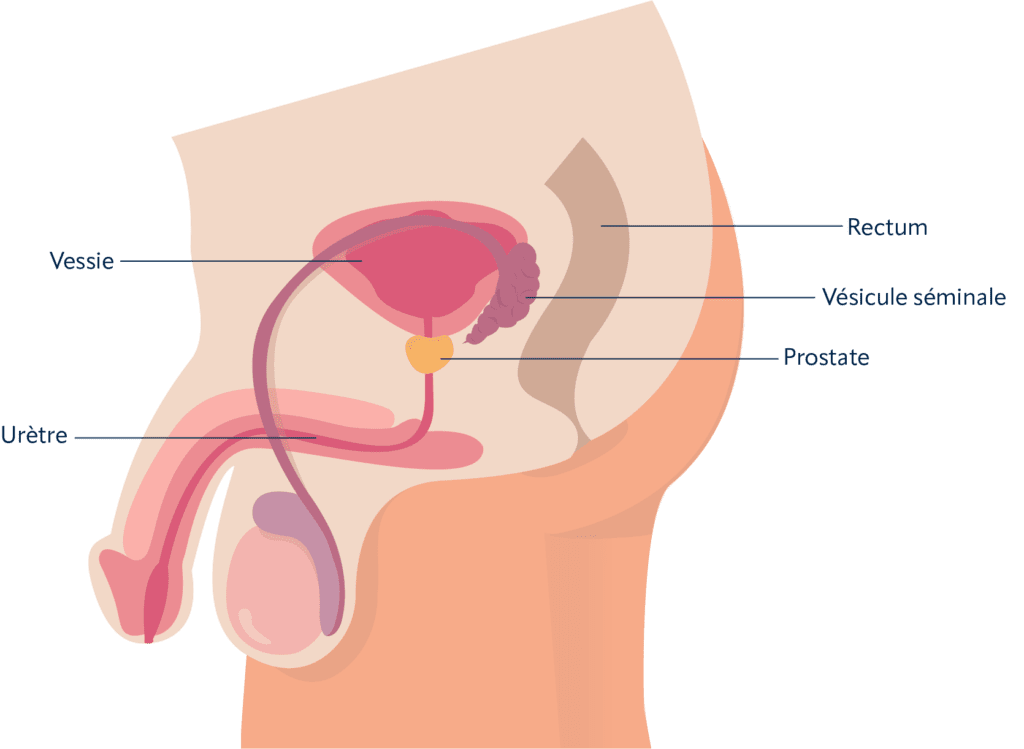
The prostate is a male genital gland located in the pelvis below the bladder and in front of the rectum. It is shaped like a chestnut and weighs around 20/25 grams. Its development begins at puberty, under the influence of male sex hormones.
Its main role is to produce prostatic fluid, which plays a part in sperm survival, maturation and motility. The development and functioning of the prostate are influenced by male hormones (testosterone), which are produced in the testicles.
The prostate surrounds the urethra, which is the conduit through which urine and semen are evacuated from the body.
With age, it can become the site of tumor development.
How common is this cancer?
Localized prostate cancer is the most common cancer in men, accounting for 25% of all male cancers. It is most often a slow-growing cancer associated with aging. It can be completely silent (with no symptoms) or cause urinary problems (difficulty urinating, more frequent urges), erectile dysfunction or a feeling of heaviness in the lower abdomen.
Rare before the age of 50, its incidence increases progressively with age. The average age at diagnosis is 68. When diagnosed at a localized stage, prostate cancer generally has a good prognosis: almost 90% of prostate cancers are in remission at 5 years.
How to diagnose?
Clinical examination:
Clinical examination often involves a digital rectal examination (DRE). The doctor looks for irregularities, hard areas or suspicious nodules that could indicate cancer. Although this examination is useful, it is not sufficient to make a definitive diagnosis.
PSA assay:
PSA stands for "Prostate Specific Antigen". It's a protein naturally produced by the prostate.
The PSA assay measures the concentration of this protein in the blood. Its level rises in cases of cancer, but also infection or adenoma of the prostate.
PSA measurement alone does not establish a diagnosis of cancer. If necessary, the doctor will prescribe additional tests to determine whether or not cancer is present. The clinical examination is performed rectally, using a digital rectal exam (DRE).
Prostate imaging and biopsy
To formally diagnose prostate cancer, samples of prostate tissue must be taken, guided by imaging tests (ultrasound, MRI of the prostate): these are called prostate biopsies. The biopsy is used to determine not only the presence of cancer, but also its grade (assessed by the Gleason system) and stage (which describes the extent of the cancer).
What treatments are available?
Several treatment options are available, depending on your age, general condition and the extent and aggressiveness of the disease. Treatment options are discussed at a multidisciplinary consultation meeting (réunion de concertation pluridisciplinaire - RCP ), which brings together several professionals (oncologists, radiotherapists, surgeons, etc.) to propose the most appropriate treatment, with the possibility of several treatment modalities.
In some cases, if the cancer is very localized with no aggressive cells on biopsies, no treatment is envisaged at first. In these cases, regular monitoring (clinical and PSA) is carried out, as the disease progresses slowly. This is known as active surveillance.
In other cases, one or more combined treatments may be considered, again depending on the individual situation.
The various treatments used in prostate cancer include:
- Surgery;
- Radiotherapy ;
- Hormone therapy;
- Chemotherapy.
Surgery
Total prostatectomy is the complete removal of the prostate gland, more or less combined with the removal of lymph nodes in the area. The procedure may be conventional, laparoscopic or robotic. Surgery is performed under general anaesthetic.
Surgery frequently has side effects:
- In particular, the risk of erectile dysfunction is relatively high. This risk is linked to the resection of the nerves controlling erection, which are located in close contact with the prostate. While these problems may diminish over time, they are often difficult to live with and accept. Help and solutions can be envisaged.
At the Centre Baclesse, you can have recourse to a onco-sexuality consultation to help you understand and find solutions. - Urinary incontinence may also occur after surgery, but this is often transient and usually disappears within a few weeks. Re-education with physiotherapy may be proposed to improve this problem.
Radiotherapy
External radiotherapy can be carried out through the skin. This involves delivering high-energy rays to the tumor in order to destroy it. Treatment lasts several weeks, with daily sessions.
External radiotherapy can lead to inflammation of the rectum (most often diarrhea) during treatment, associated with bladder irritation (frequent urination and burning when urinating). In most cases, these symptoms improve after treatment. Erectile dysfunction is also observed 12 to 18 months after treatment.
Radiotherapy can also be administered internally, in the form of brachytherapy. This involves implanting small radioactive seeds into the prostate. Brachytherapy also causes bladder irritation, intestinal disturbances and erectile dysfunction, although these disappear in the short term.
Hormone therapy
Prostate cancer is a so-called hormone-sensitive cancer, meaning that its development is stimulated by male hormones: androgens, and testosterone in particular.
Hormone therapy consists in countering the action of male hormones, which promote the growth of cancer cells, and stopping the development of the cancer.
There are several hormone therapy drugs available. The choice of treatment depends on the progression of the cancer. These treatments are given either transiently over a given period as a complement to local treatment, or on a long-term basis in the case of more advanced disease.
The following side effects are common to the different types of hormone therapy:
- hot flashes
- erectile dysfunction
- reduced libido
- weight gain
- reduced bone mass (osteoporosis)
- swelling and tenderness of the breasts (gynecomastia)
- irritability
- reduced muscle mass
A personalized support program for the introduction of second-generation hormone therapy is available at the Centre Baclesse. This program is open to all patients undergoing radiotherapy or medical oncology and benefiting from a prescription for second-generation hormone therapy.
Watch our video on hormone therapy :
Chemotherapy
Chemotherapy may be indicated for advanced prostate cancer, in combination with hormone therapy. The initiation of chemotherapy is discussed by your medical team at a multidisciplinary consultation meeting (RCP).
Other treatments
Other treatment modalities are beginning to emerge, such as metabolic radiotherapy (=internal vectorized radiotherapy). These treatments, such as "Lutetium 177-PSMA-617", consist of a vector molecule targeting cancer cells and a radioactive element emitting radiation designed to destroy all cancer cells. They can be offered in cases of advanced cancer.
Similarly, other treatments targeting cell repair have recently become available (in cases of advanced cancer).
Clinical trials
Advances in knowledge of the disease and its treatment have considerably improved prognosis.
The medical oncology team at the Centre Baclesse may also be able to offer you promising new drugs as part of national or international therapeutic innovation access programs. For example, you can take part in a therapeutic trialwhen an innovative drug or technique seems suitable for your situation, even before it becomes routinely available.
Supportive oncology care
Supportive oncology care refers to any approach or treatment that helps you to tolerate treatment better and live through the difficult situation you're in.
REMINDER
The Espace de Rencontres et d'Information (ERI) at the Centre Baclesse is at your disposal and can direct you to help and support associations.