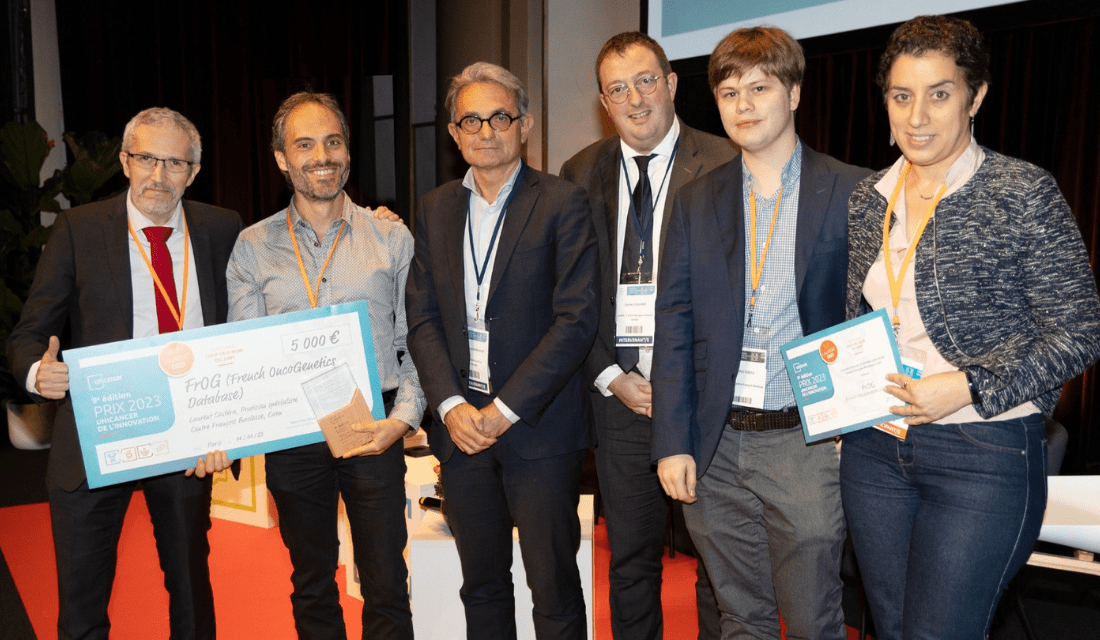
On Tuesday, November 14, 2023, the FrOG (French OncoGenetics Database) project received the Unicancer Innovation Award in the "digital/data at the service of patients" category. The award was presented at the annual convention of the French Cancer Centers in Paris.
The FrOG project is supported by :
- Laurent CASTÉRA, specialist practitioner at the Centre Baclesse
- In conjunction with Sandrine CAPUTO DURAND, scientific practitioner at the Institut Curie,
- Stéphanie BAERT-DESURMONT, pharmacist-biologist and hospital practitioner at Rouen University Hospital,
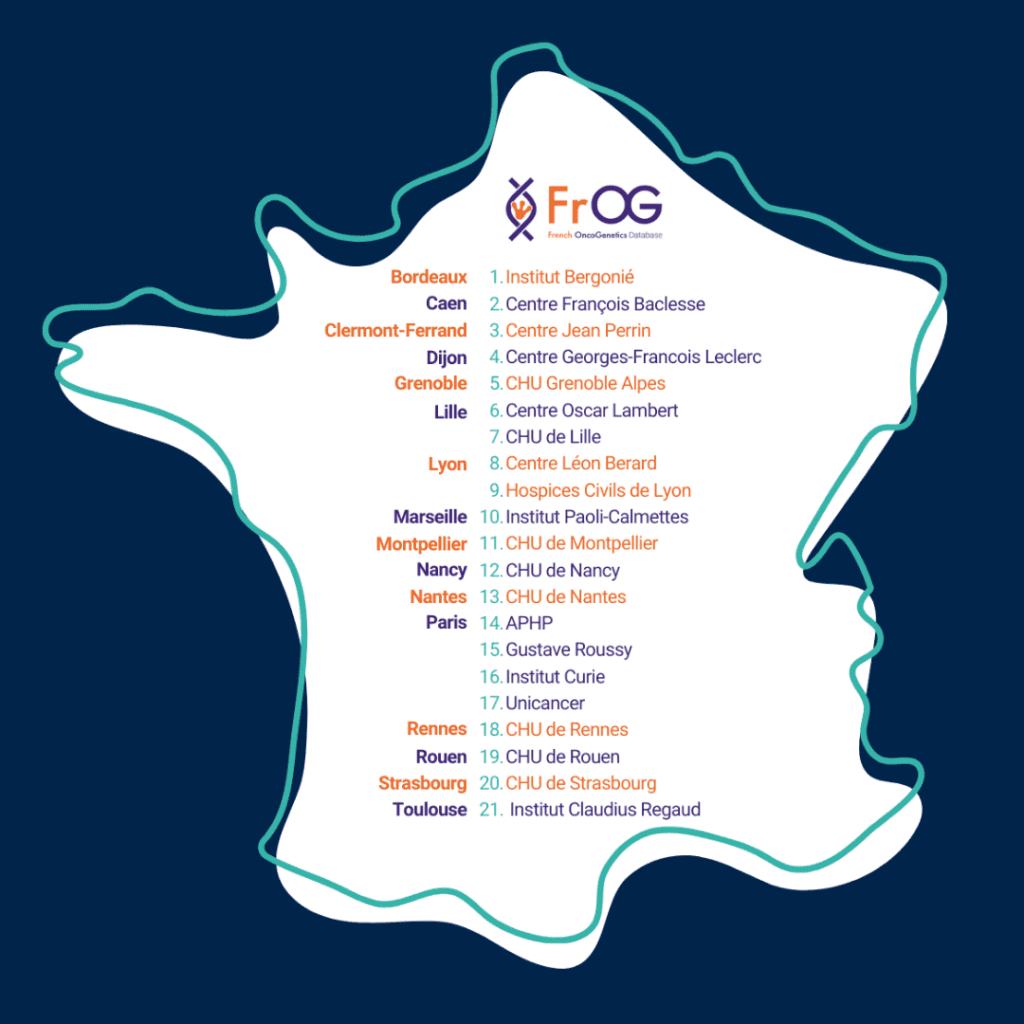
within a COPIL representing a consortium of 21 healthcare establishments (CHU and CLCC), coordinated by Unicancer, around the sharing of oncogenetic data and diagnostics.
FrOG was developed by Arthur COSTIL, a developer at the Centre Baclesse.
What is FrOG?
To ensure optimal care for families with suspected hereditary forms of cancer, the interpretation of genetic variants identified in oncogenetic laboratories must be relevant and harmonized at national level.
To improve the current system, the Genetics and Cancer Group – Unicancer (GGC)
initiated and developed a database called "FrOG (French OncoGenetics Database)".
FrOG's objective is to securely centralize cancer predisposition gene variants identified in patients seen in oncogenetic consultations, in a database enabling their annotation, curation and expertise, within a controlled regulatory environment for patient data protection aspects (RGPD), and relative to current regulations concerning health data.
The FrOG web application, accessible by member oncogenetics laboratories, integrates 13,350 variants of 13 genes identified in 47,481 patients, which can be called up via a search engine.
FrOG provides a dynamic network of oncogenetic experts, and gives greater visibility to national expertise.
How does it enable better treatment of so-called "hereditary" cancers?
Today, the diagnosis of genetic predispositions to cancers, such as breast, ovarian and colon cancer, relies on the sequencing of several genes to find genetic variants responsible for an increased risk of cancer.
Numerous genetic variants are found during these analyses: pathogenic variants explain the disease, but in 10% of patients the variant cannot be classified by biologists and remains of uncertain clinical significance, making diagnosis difficult.
By sharing their expertise, medical biologists can help each other make more relevant diagnoses. This is what the FrOG consortium is proposing: to develop the reference database for oncogenetics laboratories in France.
How does the oncogenetics database work?
The French OncoGenetics Database was created under the aegis of the Groupe Génétique et Cancer, which defines oncogenetics care in France. UNICANCER coordinates the consortium, and FrOG is used by 21 healthcare establishments, including Cancer Research Centers and University Hospitals, all members of the consortium.
The genetic variants identified by the laboratories are deposited in FrOG, and their clinical significance is then worked on and validated by the biologists in FrOG's expert groups. They are redistributed to each laboratory member of the consortium via the FrOG web interface, enabling them to harmonize the results returned in France, and make more accurate diagnoses.
This sharing of medical and expert data complies with personal data protection legislation (or RGPD). Patients seen in oncogenetic consultations are informed by the doctor or genetic counselor of the processing of their data and of their rights, thanks to an information note that will be given to them. A steering committee and working groups ensure the proper use of data.
The FrOG database has its origins in more than 20 years of networking between biologists belonging to the Groupe Génétique et Cancer.
For the past 3 years, FrOG has taken the form of a secure website, frog-db.fr, which is accessed several hundred times a day, giving biologists access to the interpretation of over 13,350 variants in 13 genes found in 47,481 patients.
It is now an indispensable diagnostic tool for patients in the French oncogenetics network, ensuring rapid, reliable and harmonized treatment. The opening up of the FrOG database beyond the members of the consortium is expected, not only in France but also beyond our borders, in the general interest of patients with hereditary forms of cancer.
Prof. Roman ROUZIER, General Manager of the Centre Baclesse, was very pleased with this joint effort:
"This involves making a wealth of knowledge available to geneticists and, ultimately, to the families being monitored. It is a collaborative effort in which experts collectively answer questions. This expertise will also be available to all patients internationally, and we can congratulate ourselves on the progress made by the FrOG program."
Laurent CASTÉRA, President of the COPIL FrOG explains that :
"The real innovation lies in the fact that 21 different institutions have managed to come together, share health data, and comply with the very strict regulations of the GDPR (General Data Protection Regulation). This is a collective effort to improve care and diagnosis of genetic predispositions to cancer. Similarly, by bringing together experts in our field, we are securing the analyses of patients in the oncogenetics network."
The 21 members of the FrOG consortium