
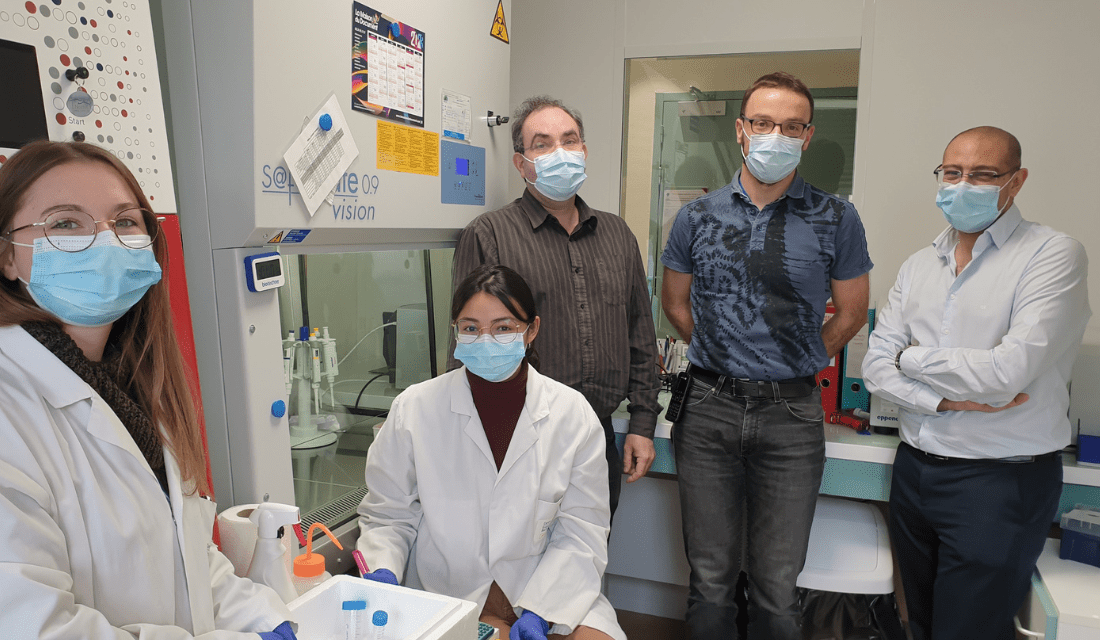
In the photo, from left to right: Romane FLORENT (ORGAPRED research engineer) , Chloé MARDE ALAGAMA (Master 1 Biology student), Laurent POULAIN, Louis-Bastien WEISWALD and Dr Georges EMILE from the Centre Baclesse.
On January 31, 2023, Baclesse's medical teams and researchers begin enrolling patients with so-called "triple-negative" breast cancer in a new clinical trial.
What is triple-negative breast cancer?
Breast cancer is the most common cancer in women, with 58,000 new cases in France in 2018. This cancer is responsible for more than 12,000 deaths per year in France. It is the leading cause of cancer mortality in women (Source: INCa 2018). One French woman in 7 will develop breast cancer during her lifetime.
Triple-negative breast cancer accounts for 10-15% of breast cancers diagnosed each year. Triple-negative" means that tumor cells express neither hormone receptors (estrogen and progesterone) nor the HER2 receptor. This means that certain drug treatments (hormone therapy and targeted anti-HER2 therapy) will not be effective.
Triple-negative breast cancer occurs in younger patients (under 40). Compared with other breast cancers, the risk of recurrence is higher for triple-negative breast cancer (Source: Anders and Carey, 2009).
The TRIPLEX study
The aim of the study is " to test different treatments on patient tumors reproduced in the laboratory, in order to determine which treatment will be the most effective ", explains Dr Georges EMILE, medical oncologist and head of the breast unit at the Centre Baclesse. " In breast cancer, it takes an average of 10 years to judge the benefit of a molecule. It ' s only today that we have the survival results of some of the trials that were carried out in the 1990s, " he continues. " With the discovery of organoids, the time needed to assess the potential benefit of a new treatment is considerably shorter.
The key role of tumor organoids in this trial to predict response to treatment
What is a tumor organoid and how does it work?
During breast surgery, the tumor is removed. Tumors operated on at the Centre François Baclesse are then used, with the patient's consent, by the ORGAPRED University platform team, and are dissociated to extract tumor cells, which are then placed in a protein gel with growth factors, so that some of them form microtumors.
These structures are very close to the original tumor and allow 2 things to happen:
- We can expose them to new therapies and identify effective new molecules.
- Eventually, we'll be able to develop personalized medicine for each patient. In other words, we could expose the microtumors to a range of existing treatments and see which would be the most effective, then administer it to the patient.
Organoids are also a revolution in traditional research, since they make it possible to avoid animal experimentation in a number of cases.
" The work of our medical and research teams is entirely dedicated to improving cancer treatment. It was therefore only natural that we should concern ourselves with the growing importance of so-called precision (or personalized) medicine, thanks to the introduction of functional tests based on ex vivo culture of breast tumor samples, " says Dr Georges EMILE.
In vitro, in vivo... and now ex vivo
Health research has traditionally relied on in vitro ("in the glass") analyses of cells grown in two dimensions (2D) in the laboratory. However, even if the analyses are conclusive, the results obtained in vitro remain incomplete and are not always consistent with clinical results (observed in patients), since tumor cells are isolated from their environment, grow in 2D rather than 3D, and their molecular characteristics progressively diverge from those of their original tumor. When they are conclusive, they are often followed by in vivo ("in the living", in animals) studies, the latter being more relevant from the point of view of the complexity of biological systems.
The intermediate solution could come from analyses carried out ex vivo ("outside the living world") on special three-dimensional structures that reproduce certain characteristics of the organ or tumor from which they originate, known as "organoids". " Organoids have characteristics and functions that reflect the complexity of the living world," explains Laurent POULAIN, PhD in biology and co-manager of the ORGAPRED platform. " This makes them excellent tools for both clinical and fundamental research.
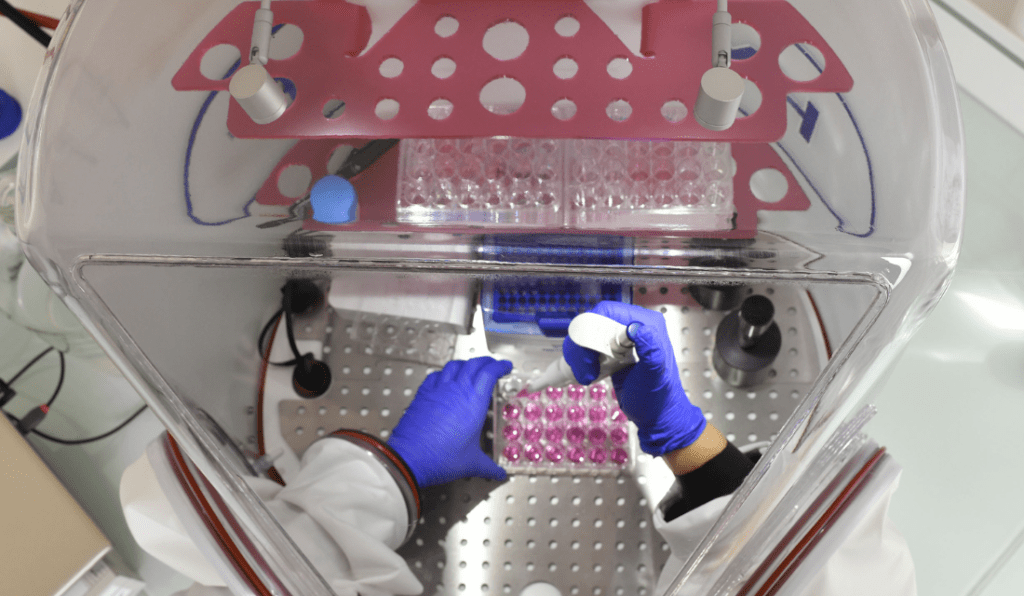
At Baclesse, more than 30 years of research into ovarian cancer has opened up new avenues of research into other pathologies.
In Caen, the ANTICIPE research unit has been working on ovarian cancer for over 30 years. "Relapses are frequent in ovarian cancer, with some tumors developing resistance mechanisms to first-line treatments," explains Laurent POULAIN. Hence the need to identify these mechanisms and predict response to treatment, in order to propose personalized therapeutic protocols.
" Every oncologist's dream is to be able to produce a tumor organoid from a patient's tumor cells, then subject it to different treatments to identify the most effective and administer it to that patient! "
It was in 2017 that the ANTICIPE research unit set out on this path - a long journey and a methodological feat. " It took us almost two years to develop the methods for culturing, analyzing and preserving ovarian tumor organoids," points out Louis-Bastien WEISWALD, PhD in biology and co-leader of the ORGAPRED platform.
The field of possibilities has expanded considerably, as trials are also underway with tumor organoids from gastro-oesophageal and upper aerodigestive tract cancers, with more to come for other localizations.
How does the TRIPLEX trial work in practice?
Three major scientific phases are planned
1) Can organoids be created from simple biopsies?
"The novelty lies in the fact that tumor organoids will be recreated from simple biopsies, rather than from the tumor extracted during surgery. The trial will first demonstrate whether or not it is possible to produce organoids from a very small quantity of tumor cells", explains Louis-Bastien WEISWALD.
2) Do biopsied organoids respond to treatment in the same way as patients included in the trial?
If step one is validated, the organoids will receive the same treatment as the patients included in this trial. The aim is to determine whether the results are the same in the organoids as in the patients. If the response to treatment is identical, the predictive value of organoids derived from tumor biopsies will be demonstrated.
3) Is it possible to use a predictive test for treatment response?
If the previous two steps are validated, we will then be able to carry out predictive tests for treatment response and offer personalized medicine for each patient.
This research innovation is expensive. The trial is expected to cost €500,000 and involve 164 patients over 4 years.
The ORGATHEREX and ORGAPRED projects are co-financed by the European Union, the Normandy Region under the FEDER/ FSE 2014-2020 operational program, and by the French State under the Contrat de Plan Etat-Région Bas-Normand 2015-2020.
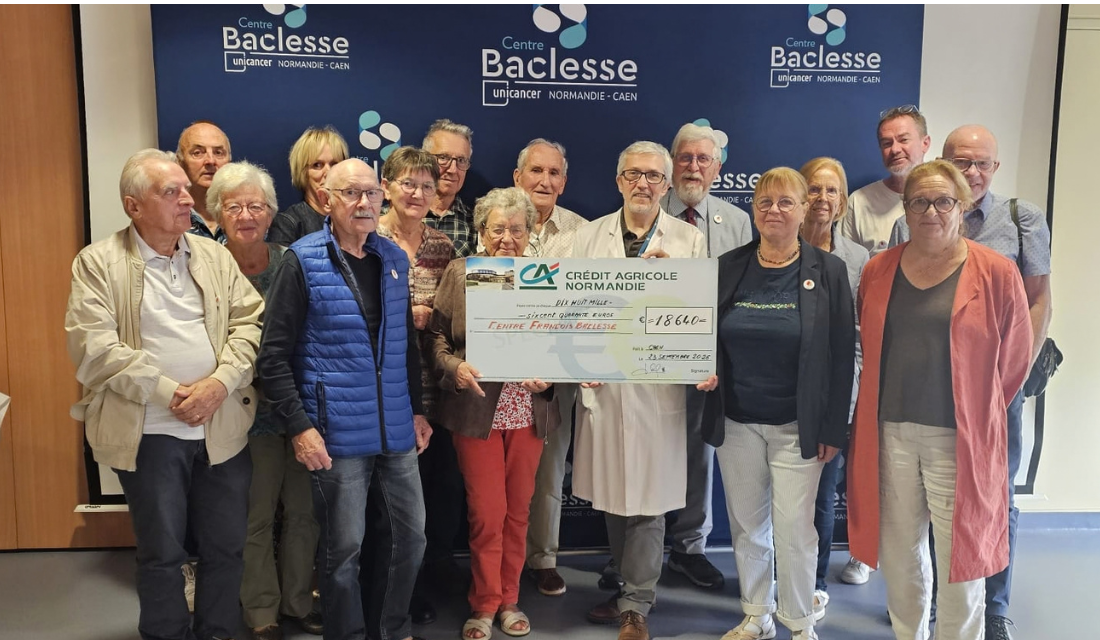
Many donors have also supported breast cancer research at the Centre Baclesse, and we thank them. Donations are always welcome to speed up the development of research.