
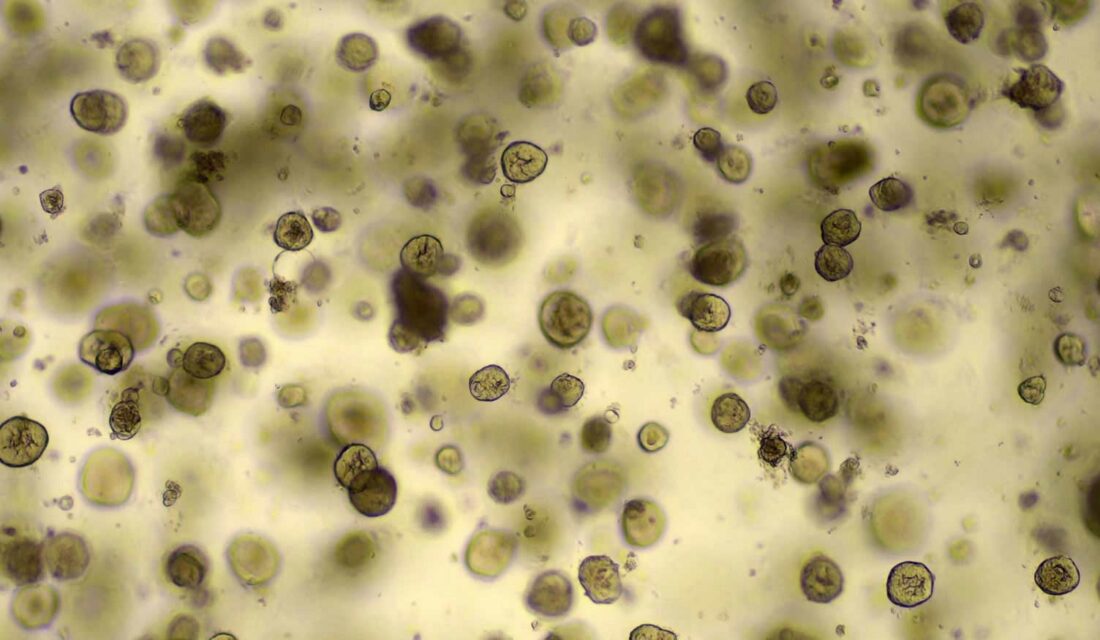
Photo © ORGAPRED : mini-cancer tumors.
Article from Prisme, the research journal of the Université de Caen Normandie(No. 12 - July 2021)
The ORGAPRED platform produces miniature copies of cancerous tumors, using real cell samples from tumor tissue. The aim? To use these "mini-tumors" to test and predict patient response to medical treatments. Here's how it works.
In vitro, in vivo... and now ex vivo
Health research has traditionally relied on in vitro ("under glass") analyses of cells grown in the laboratory, which, if conclusive, are followed by in vivo ("in the living") studies, the latter being more relevant from the point of view of the complexity of biological systems. But even if the analyses are conclusive, the results obtained in vitro will nevertheless remain incomplete, as the cells, which lie at the bottom of their cylindrical box, are isolated from their environment.
The intermediate solution could come from analyses carried out ex vivo ("outside the living world") on 3D reproductions of organs, tumors or tissues called "organoids". " Organoids have characteristics and functions that reflect the complexity of living organisms, " explains Laurent Poulain, PhD in biology and co-director of the ORGAPRED platform. "This makes them excellent tools for both clinical and fundamental research. "
Towards predictive medicine
In Caen, the ANTICIPE research unit has been working on ovarian cancer for over 30 years. " Relapses are frequent in ovarian cancer, with some tumors developing resistance mechanisms to first-line treatments ," explains Laurent Poulain. Hence the need to identify these mechanisms in order to predict response to treatment, and thus propose personalized therapeutic protocols.
" Every oncologist's dream is to be able to produce a tumor organoid from a patient's tumor cells, then subject it to different treatments to see which will be most effective on that patient! "
It was in 2017 that the ANTICIPE research unit set out on this path - a long journey and a methodological feat. "The idea is to recover cells which, once placed in a matrix containing various growth factors, will evolve in 3D, until they become micro-tumors close to the original tumor," explains Louis-Bastien Weiswald, PhD in biology and co-leader of the ORGAPRED platform.
" It took us three years to develop the methods for culturing, analyzing and preserving ovarian tumor organoids. "
The prospects are many: organoids could also be used to evaluate the action of a pharmaceutical molecule, validate new therapeutic strategies or identify biomarkers of response to treatment.
Meeting the needs of researchers and clinicians
This expertise soon attracted external requests, giving rise to the idea of a platform dedicated to the production of tumor organoids. " We approached a research unit in Lille that was also working on these methods," continues Louis-Bastien Weiswald.
"We worked together to create two partner platforms and coordinate our efforts to best meet the needs of researchers and clinicians throughout the Cancéropôle Nord-Ouest cancer research network. " This is how ORGAPRED was created in Caen in 2020, with around 40 organoid lines derived from ovarian, upper aerodigestive tract, colon, pancreatic, and breast cancer tumors already in its catalog.
In Lille, the ORGARES platform specializes in organoids derived from cancerous tumors of the lung and digestive tract. Structuring is also continuing at national level, with the network of "Organoids" platforms to be accredited by the CNRS in 2021. " These new analysis methods, which are currently booming, will become essential in the future: the idea is to coordinate to work together, share know-how, and exchange our models, in the service of health research, " concludes Laurent Poulain.
The ORGAPRED platform is co-financed by the European Union, the Normandy Region as part of the ERDF/ESF 2014-2020 operational program, and the French government.